IDC Kuwait CIO Summit 2025

Architecting an AI-Fueled Business

Kuwait City, Kuwait

Architecting an AI-Fueled Business

‘IDC

Overview

Kuwait is experiencing a dynamic economic shift as the country accelerates its digital transformation agenda in alignment with Vision 2035. This strategic initiative aims to position Kuwait as a regional and international financial and trade hub, enhancing its appeal to investors while fostering a competitive, efficient private sector. Key to this vision is the adoption of advanced technologies like cloud computing, artificial intelligence, IoT, big data, sustainability, and cybersecurity solutions, driven by government efforts to create a business-friendly environment underpinned by strong national values and social development. With a focus on fintech and Smart City projects, Kuwait is poised to strengthen its role as a regional tech leader and innovation hub. Indeed, IDC's META Digital Executive Survey revealed that 61% of organizations in the GCC are already prioritizing AI investments for the next 12 months, highlighting the substantial impact of the technology across the region.

Business and technology leaders in Kuwait are encountering a range of opportunities and challenges as they work to harness the full potential of AI within the context of Vision 2035. To be well prepared, they must stay informed about key developments in real time and develop long-term strategies that ensure the most efficient, cost-effective, and reliable AI implementations. This includes scaling GenAI technologies across business processes and IT infrastructure. By doing so, Kuwaiti organizations can effectively navigate the complexities of an AI-driven world, enhancing business agility and fostering innovation while managing the associated risks.

The 2025 edition of the IDC Kuwait CIO Summit will feature a stellar lineup of C-suite executives, influential analysts, industry thought leaders, international speakers, and market-leading solution providers. Together, they will discuss AI's role as the leading technology enabler of business strategy and the endless potential it provides enterprises across the region. This premier gathering of ICT experts will examine the industry's hottest topics, trends, and challenges, providing essential guidance on adapting to an unpredictable business landscape, implementing new business models, and scaling massively in the AI-powered digital economy.

Key Themes

AI Everywhere

Digital Business strategies

Digital Economy Trends

2024 Events Highlights

IDC Kuwait Advisory Council 2025

‘IDC

Agenda

Tuesday May 20, 2025
8:30

Registration & Networking

9:00

IDC Welcome Address

9:05

Opening Address

9:20

Advisory Council Members Felicitation

9:30

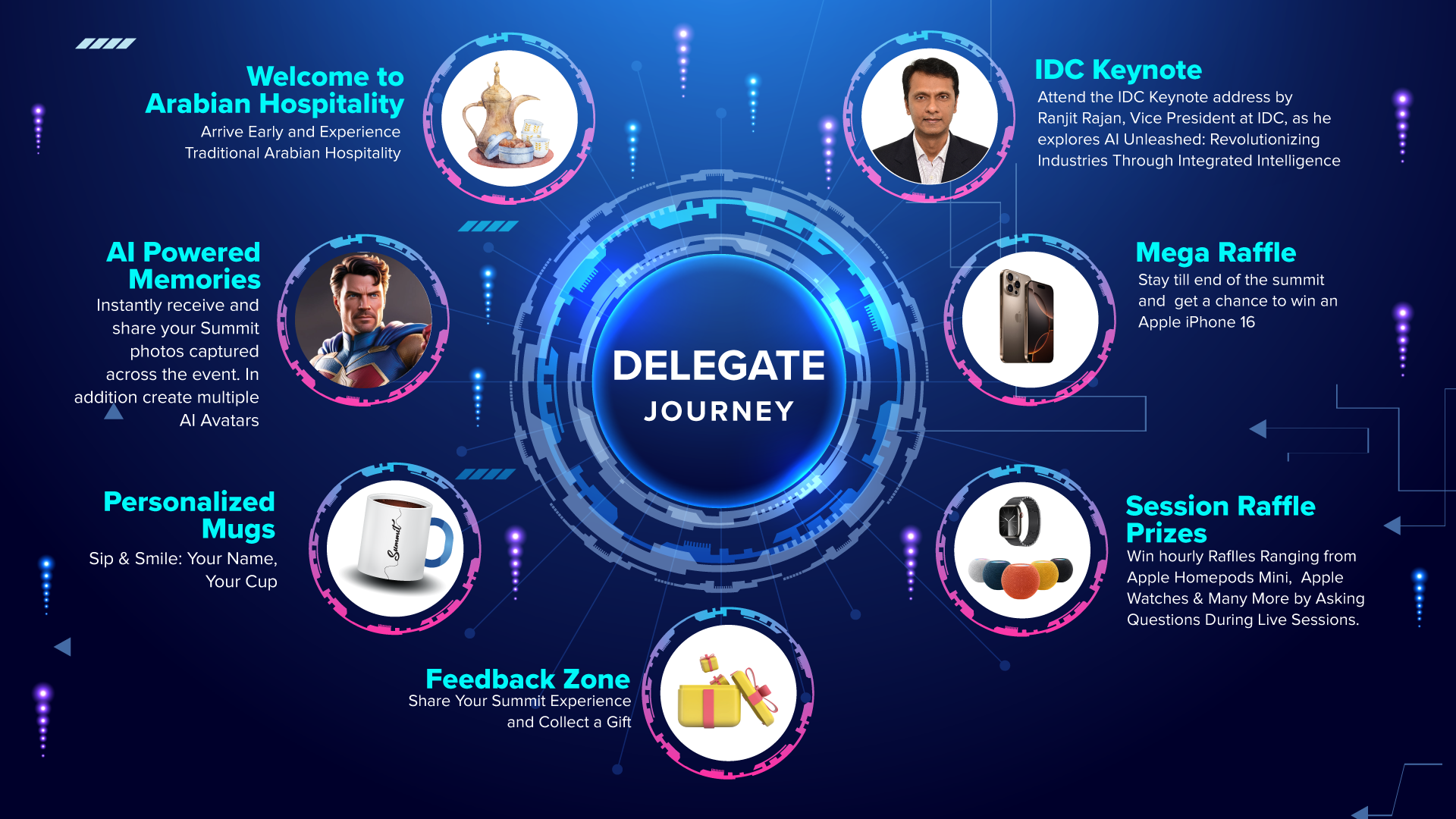
IDC Opening Keynote: AI Unleashed: Revolutionizing Industries Through Integrated Intelligence

10:00

Future Proof | AI Governance

10:20

Building the future with AI

10:40

Powering Datacenters in the AI Era

10:55

Ask Questions, Rate Sessions & Stand a Chance to Win Apple Homepod Mini

11:00

Tea / Coffee & Networking Break

Platinum Session

11:35

Start of Session Raffle - Apple Watch

11:40

Safeguarding Kuwait’s Vision 2035 in the Age of Intelligent Threats

11:55

Ask Questions, Rate Sessions & Stand a Chance to Win Apple Homepod Mini

12:00

Fortifying Your Data Estate

12:15

Ask Questions, Rate Sessions & Stand a Chance to Win Apple Homepod Mini

Technology Focus Group Session

12:20

Overcoming Money Mules : Collaboration to Eliminate Complexity

12:30

Ask Questions, Rate Sessions & Stand a Chance to Win Apple Homepod Mini

12:35

The Age of Agentic AI: What Leaders Need to Know

12:45

Ask Questions, Rate Sessions & Stand a Chance to Win Apple Homepod Mini

12:50

Announcement of the Session Winner

For the CIO By The CIO Sessions

12:55

Cross-Functional Collaboration in the Future Enterprise

13:25

Driving Innovation While Safeguarding Against Spiraling Costs: Smarter IT Spending

13:55

Mega Raffle-Submit your Raffle Coupon & Stand a chance iPhone 16

14:00

Lunch & Networking

15:00

Close of Event

Speakers

Wahab Bou Hamdan

Events Audience Development Manager

Najat Hussain Ibraheem

Acting Director General, Central Agency for Information Technology (CAIT)

Ranjit Rajan

Vice President, Research (META), IDC

Tamer Charife

Partner, Cyber Strategy & Transformation, Deloitte Middle East

Saad Ouchkir

Director, Customer Engineering, Google Cloud

Manuel Rodrigues

VP Secure Power - Gulf, Schneider Electric

Ezzeldin Hussein

Senior Director for Security Engineering, SentinelOne

Ashokan KPV

Senior Cybersecurity Consultant, Thales

Hanan AlQahtani

GCC Sales Director, Mozn

Dr. Jamshaid Ashraf

Chief Technology Officer, Digital Processing Systems

Salem Almulaifi

Advisor to the Minister of Commerce and Industry, Kuwait

Rami AlHaddad

Group CIO, Menzies Aviation

Lamya Al Tabtebai

Group Chief Data Officer, Kuwait Finance House

Sulaiman Ne'emah

Chief Customer Experience Officer, Kuwait Credit Information Network Company - CINET

Dr. Dheeraj Bhardwaj

CEO, door2door/Citylink Shuttle

Abdulla Al-Awadi

General Manager, Strategy & Change Management, Kuwait International Bank

Essa Haidar

Chief Technology Officer, Ooredoo

Praful Thummar

Vice President IT, Jazeera Airways

View All Speakers

Partners

Strategic Government Partner
Government Supporting Partner
Host Partner
Strategic Partner
Summit Partner
Platinum Partner
Platinum Partner
Technology Focus Group Partner
Exhibit Partner
Exhibit Partner
Associate Partner

Venue

Courtyard by Marriott Kuwait City
Al Shuhada Street Kuwait City, 15463, Kuwait

Knowledge Hub

Analyst Spotlight
The AI Everywhere Era in the Public Sector

Massimiliano Claps,
Research Director, IDC


AI and GenAI are having an increasingly pervasive impact on government — across missions, use cases, processes, and systems — in the Middle East and beyond. The disruptive impact of these technologies, compounded by geopolitical volatility, technical debt, digital sovereignty concerns, elevated citizen expectations, and regulatory changes, will require government leaders to approach innovation holistically. The acquisition and implementation of new technologies will not be enough. Realizing the benefits of AI, cloud, and industry platforms will require revisiting governance, risk management, culture, and the building of competencies to accelerate innovation.

Analyst Spotlight
Enabling AI Outcomes with Cybersecurity

Frank Dickson,
Group Vice President, Security & Trust, IDC


GenAI was coming. Predictive AI was coming.  No . . . wait, it was already here. Anyway, we sit here today focused on the art and the genuineness of the possible.

As we consider and dream of the possible, we sometimes forget the reality of the now. Between the hype around GenAI and the COVID-19 pandemic before that, we sometimes fail to acknowledge that cybersecurity has grown up. Once the dominion of hoodie-wearing basement dwellers, the topic has elevated to the C-suite and beyond. Attacks from the cyberthreat landscape do not just present a technical risk — the ramifications create a risk to the organization itself. In essence, cyber risk equals business risk.

Partner Spotlight
What Is Agentic AI and Why It Matters

Dr. Jamshaid Ashraf,
Chief Technology Officer, Digital Processing Systems

Agentic AI is the next evolution in artificial intelligence — moving beyond generative AI like ChatGPT or DALL·E, which create content based on user prompts. In contrast, agentic AI can act independently, make decisions, and learn from experience without constant human direction.

Unlike traditional AI agents that follow predefined rules to perform specific tasks (like chatbots or virtual assistants), agentic AI systems perceive their environment, reason through problems, take actions, and continuously improve over time. A strong example is self-driving cars that analyze real-time conditions and navigate autonomously.


Partner Spotlight
The Perfect Storm: A Perspective on Unlocking AI's Value in Middle East

Yousef Barkawie,
Partner, AI & Data, Deloitte Middle East

From leading use cases being implemented to barriers hindering wider adoption, Deloitte's "State of AI in the Middle East Report" sheds light on the key trends shaping the AI landscape in the Middle East.

Organizations across the Middle East are accelerating their AI investments at an unprecedented rate, yet many are missing the crucial building blocks to unlock its full potential. Over 80% of organizations feel the intense pressure to adopt AI, but nearly half struggle with a shortage of talent and technological capabilities necessary for successful scaling. This high-pressure environment, coupled with significant investments and a lack of readiness in talent and infrastructure, is creating a perfect storm for Middle Eastern organizations, with a third not seeing any returns from their AI initiatives.

Partner Spotlight
AI vs. Money Mule Networks: How GCC Financial Institutions Can Stay One Step Ahead

Malik Alyousef,
Co-Founder & Chief Operating Officer, Mozn

Financial crime in the Middle East is evolving fast, and nowhere is this more evident than with the increase in money mule networks that funnel illicit funds through seemingly ordinary current accounts. As the GCC becomes an increasingly attractive region for financial crime with the rise in investments and business activity, AI — specifically large-language models (LLMs) — promises to turn the tide in combatting financial crime.

Contact Us

Ronita Bhattacharjee

Vice President - Conferences, IDC Middle East, Africa, & Turkey

+971 4 391 2747

IDG

IT executives worldwide rely on IDG’s technology events to discover new ideas, trends, and solutions. Leveraging 60 years of IDC’s market intelligence and Foundry’s media brands (CIOCSOComputerworldInfoWorldNetwork WorldARNReseller NewsChannelPartnerChannel AsiaITWorld), these events offer powerful learning and networking experiences.

Held in more than 30 countries, they foster networking, collaboration, engagement, and knowledge sharing among industry leaders and professionals. Each event is meticulously curated to provide valuable insights and meaningful connections through analysts and editor-led content, global perspectives, case studies presented by the world’s leading tech companies and a range of interactive formats including expert panels, live demos, roundtables, 1:1 meetings and workshops.

Partner Spotlight
AI vs. Money Mule Networks: How GCC Financial Institutions Can Stay One Step Ahead

Malik Alyousef,
Co-Founder & Chief Operating Officer, Mozn


Financial crime in the Middle East is evolving fast, and nowhere is this more evident than with the increase in money mule networks that funnel illicit funds through seemingly ordinary current accounts. As the GCC becomes an increasingly attractive region for financial crime with the rise in investments and business activity, AI — specifically large-language models (LLMs) — promises to turn the tide in combatting financial crime.

A Closer Look at the Mule Playbook

Picture a new expatriate to the GCC who has just opened a salary account. Within weeks, a social media contact offers "easy money": allow a few deposits, keep a small commission, and forward the rest. The deposits are modest — often $10–500 — and arrive through ATMs or cash deposit machines scattered across Dubai, Doha, Kuwait, or Riyadh. Seconds after each deposit clears, automated instructions trigger a low value fast payment transfer to another account in the region, which in turn forwards the money to a prepaid card or cryptocurrency exchange.

Technically, the operation hinges on three layers:

1. Structuring: Breaking a large criminal payoff into dozens of micro transactions to avoid threshold based alerts.
2. Multi Rail Hopping: Bouncing funds across domestic instant payment rails, SWIFT low value corridors, mobile wallets, and even crypto off ramps.
3. Rapid Consolidation: Re aggregating the money in offshore or high risk jurisdictions within hours before any single bank spots the big picture.

Viewed in isolation, each hop seems harmless; however, together they launder millions. Detecting that pattern in real time requires more than rigid rules — it demands contextual reasoning at scale, the very forte of LLMs.

How AI Reveals Hidden Mule Patterns

Traditional machine learning models excel at crunching structured ledgers, but they struggle when signals are buried in free text payment references, onboarding notes, or open source chatter. LLMs close that gap.

Vector Enriched Monitoring

By embedding both structured fields (amount, channel, geography) and unstructured descriptors ("loan repayment," "family gift") into a shared vector space, financial institutions can measure semantic similarity and flag clusters of accounts that exhibit mule like behavior — even if the keywords differ.

Dynamic Behavioral Narratives

LLMs can compare live activity with the customer's own story. If onboarding records describe a $5,000 monthly salary but the customer suddenly processes $28,000 in six days, the model produces a narrative: "Profile deviation: Income 50x baseline, cross border pattern — escalate." Investigators receive both the alert and an LLM generated explanation, cutting case times dramatically.

Graph Reasoning at Scale

When transaction data is converted into a graph, LLMs can summarize the shortest suspicious paths — for example, "Four dormant KSA accounts relay funds to a UAE exchange within 27 minutes." Such natural language graph insights make complex networks intelligible to analysts.

Investigation Copilots

Once a case is opened, LLMs draft Suspicious Activity Reports, pull in open source intelligence (e.g., recruitment ads for "quick cash"), and suggest follow up questions — slashing investigative workloads and standardizing quality.

Red Flags Every Financial Institution Should Track

While LLMs do the heavy lifting, success still hinges on capturing the right data. Key indicators include:

Multiple cash deposits in different GCC cities within short intervals.
Third party deposits from individuals unrelated to the account owner.
Immediate outward transfers or withdrawals after each deposit.
Sudden spikes in volume for a previously dormant or low income account.
Personal accounts behaving like business hubs, with many counterparties and overseas remittances.

Institutions that feed these signals into an LLM enabled monitoring fabric gain a decisive advantage: sharper detection with fewer false positives.

Are You Technologically Ready? A Holistic Framework

Deploying LLMs profitably is about more than algorithms; it is a multidisciplinary readiness exercise. The accompanying checklist screenshots outline the essentials — below is a narrative synthesis tailored for GCC financial institutions:

• Data Infrastructure & Integration: A scalable data lake or warehouse must ingest core banking, card, wallet, and external data in real time. Without seamless pipelines, mule patterns remain invisible.
• Data Quality & Consistency: Automated cleaning, standardized schemas, and regular audits are non-negotiable. Garbage in, garbage out — especially true when micro transactions are involved.
• Computational Firepower: LLM inference demands bursts of GPU/CPU capacity. Elastic cloud clusters — ideally in a hybrid multicloud configuration — ensure financial institutions can enlarge graph queries on demand, then scale down to control cost.
• Security & Compliance: Encryption, strict RBAC, and alignment with GCC PDPLs safeguard sensitive customer data and maintain regulator trust. Continuous security audits close the loop.
• Stack Compatibility: Open APIs and event buses must slot LLM micro services into existing AML engines and case management workflows with minimal friction.
• Business Continuity: Active active replicas for embeddings, models, and alert queues prevent downtime that criminals could exploit to move funds undetected.

Analytics Tracking for Optimization

Real-time analytics tracking is essential to optimize financial crime detection and response. Dashboards and predictive models, such as those provided by FOCAL Financial Crime Analytics, enable institutions to monitor transaction patterns, reduce false positives, and prioritize high-risk alerts, enhancing efficiency and compliance outcomes.

Oversight should rest with a CIO led governance board that enforces responsible AI principles — fairness, explainability, cost control — while championing the cultural shift required for AI first compliance.

Partner Spotlight
The Perfect Storm: A Perspective on Unlocking AI's Value in Middle East

Yousef Barkawie,
Partner, AI & Data, Deloitte Middle East


From leading use cases being implemented to barriers hindering wider adoption, Deloitte's "State of AI in the Middle East Report" sheds light on the key trends shaping the AI landscape in the Middle East.

Organizations across the Middle East are accelerating their AI investments at an unprecedented rate, yet many are missing the crucial building blocks to unlock its full potential. Over 80% of organizations feel the intense pressure to adopt AI, but nearly half struggle with a shortage of talent and technological capabilities necessary for successful scaling. This high-pressure environment, coupled with significant investments and a lack of readiness in talent and infrastructure, is creating a perfect storm for Middle Eastern organizations, with a third not seeing any returns from their AI initiatives.

Deloitte AI Institute research indicates that while AI offers tremendous opportunities for organizations in the Middle East, achieving success demands a robust foundation in talent, technology, and strategic capabilities. To thrive, organizations must strengthen these core areas while keeping up with the region's ambitious AI adoption pace.

Deloitte’s "State of AI in the Middle East Report" offers a timely and insightful snapshot of how businesses in the region are navigating the rapidly evolving AI landscape, with a particular emphasis on the transformative potential of generative AI (GenAI). Despite the mounting pressure on business leaders in the Middle East to adopt AI and ramp up investments, the report reveals a critical disconnect between their ambitious goals and the availability of the necessary talent and tools.

By offering this comprehensive perspective, this report aims to empower business leaders in the Middle East with the insights required to navigate the complexities of AI adoption. It provides the knowledge needed to make informed investment decisions and unlock AI's transformative potential for their organizations. Armed with this information, organizations can successfully steer through the perfect storm surrounding them and emerge victorious.

Partner Spotlight
What Is Agentic AI and Why It Matters

Dr. Jamshaid Ashraf,
Chief Technology Officer, Digital Processing Systems


Agentic AI is the next evolution in artificial intelligence — moving beyond generative AI like ChatGPT or DALL·E, which create content based on user prompts. In contrast, agentic AI can act independently, make decisions, and learn from experience without constant human direction.

Unlike traditional AI agents that follow predefined rules to perform specific tasks (like chatbots or virtual assistants), agentic AI systems perceive their environment, reason through problems, take actions, and continuously improve over time. A strong example is self-driving cars that analyze real-time conditions and navigate autonomously.

Agentic AI is being applied across industries to automate complex workflows, enhance customer support with emotional intelligence, and assist in data-driven decision-making. For example, it can reroute deliveries based on traffic conditions or monitor patient health data to detect early warning signs.

The value of agentic AI lies in its ability to boost efficiency, reduce operational costs, and enable faster, smarter decision-making. By automating complex tasks and adapting in real time, these systems free up human teams for strategic work — driving innovation, improving customer experiences, and giving organizations a strong competitive edge.

However, with its power comes challenges — particularly around security, oversight, and data readiness. Agentic AI systems require large volumes of high-quality, well-structured data to operate effectively. Yet many organizations still struggle with siloed systems and inconsistent data standards.

To fully realize the benefits of agentic AI, businesses must invest in data preparation, build flexible infrastructure, and equip their teams to work alongside intelligent systems. Companies that act early will be best positioned to lead in innovation, agility, and customer experience.

Agentic AI is coming fast. The question is — will your organization be ready?

Analyst Spotlight
Enabling AI Outcomes with Cybersecurity

Frank Dickson,
Group Vice President, Security & Trust, IDC


GenAI was coming. Predictive AI was coming.  No . . . wait, it was already here. Anyway, we sit here today focused on the art and the genuineness of the possible.

As we consider and dream of the possible, we sometimes forget the reality of the now. Between the hype around GenAI and the COVID-19 pandemic before that, we sometimes fail to acknowledge that cybersecurity has grown up. Once the dominion of hoodie-wearing basement dwellers, the topic has elevated to the C-suite and beyond. Attacks from the cyberthreat landscape do not just present a technical risk — the ramifications create a risk to the organization itself. In essence, cyber risk equals business risk.

Unlike many other corporate functions, cybersecurity did not develop from the typical path of strategy, goals, policies then tactics. It started in reverse with tactics first, then policies, then goals, and finally to strategy — if it made it there at all. The result is that formal strategy is really more of an amalgamation of small tactical decisions over time. This opportunistic cybersecurity strategy creation makes it challenging for organizations that are looking to create competitive advantages with AI. Thus, security needs to evolve from the tactical to the strategic, from being reactive to being proactive, from being an inhibitor to an enabler.

Cybersecurity leaders must now think strategically and act as business leaders alongside the executives of their organizations — creating insights, aiding executives in decision-making, and showing an organization's risk posture are all critical for cybersecurity leaders' success in today's fast-changing threat landscape and regulatory environment.

The IDC Kuwait CIO Summit looks to address security in this new reality of security becoming an enabling function for AI-created competitive advantage. We aim to guide you in working with the CEO and board of directors as we transition to delivering secure outcomes and a trusted organization to our executive constituencies.


Analyst Spotlight
The AI Everywhere Era in the Public Sector

Massimiliano Claps,
Research Director, IDC


AI and GenAI are having an increasingly pervasive impact on government — across missions, use cases, processes, and systems — in the Middle East and beyond. The disruptive impact of these technologies, compounded by geopolitical volatility, technical debt, digital sovereignty concerns, elevated citizen expectations, and regulatory changes, will require government leaders to approach innovation holistically. The acquisition and implementation of new technologies will not be enough. Realizing the benefits of AI, cloud, and industry platforms will require revisiting governance, risk management, culture, and the building of competencies to accelerate innovation.

Realizing the Value of AI at Scale in the MEA Region

The advent of GenAI prompted a surge of experimentation. Governments piloted GenAI for task automation, such as summarizing meeting minutes, drafting RFI and RFP documents for public tenders, creating job requisitions, synthesizing information to respond to freedom of information requests, and conducting research for the preparation of policy briefs. As pilot projects empowered them to evaluate benefits and risks, national governments and smart cities started to invest in scaling both traditional AI/ML and GenAI systems to address more complex industry-specific scenarios, such as service and benefits personalization, clinical care, and traffic safety. AI-enabled digital assistants started to help citizens interact with systems through conversational interfaces, instead of having to scroll through screens and fill out forms. Employee digital assistants started to help expert government case managers review, validate, and respond to citizen requests in a more holistic and personalized manner.

AI-powered governments will need to rethink their strategies, governance, people, and technologies to effectively adopt AI. This radical transformation will require governments to establish senior leadership roles that can build organizational capacities and competencies; design and enforce governance policies, structures, and processes; and deploy data and AI infrastructure, platforms, and application capabilities that align with strategic mission goals — all while complying with regulation. The MEA region is leading the charge; for instance, the Dubai government appointed 22 chief artificial intelligence officers (CAIOs) in 2024.

To achieve this level of automation, CAIOs need to work with line-of-mission and program leaders to re-engineer processes and systems so they can apply algorithms that recognize changes in their constituents' circumstances, identify the root causes, and trigger operational workflows or dynamically reconfigure services and programs to meet constituents' evolving needs and preferences.

From an architectural standpoint, this level of end-to-end process automation will require a combination of agents that will provide multimodal capabilities to process text, rules, and images, and will be orchestrated to deliver intended outcomes across end-to-end workflows.

To generate the desired outputs and outcomes from the application of AI and GenAI, government CAIOs and chief data officers need to feed data-hungry algorithmic training and fine-tuning. To avoid using low-quality datasets, which grow bias and hallucination, lower accuracy, and increase the risk of intellectual property infringement and other ethical and compliance risks, governments will invest in data logistics and control planes and establish governance polices and processes that enable them to control quality, reliability, and integrity of datasets.

Hybrid, multicloud environments are becoming the cornerstone for governments wanting to modernize their infrastructure, transform their applications, and take advantage of innovations such as AI and GenAI. FinOps practices and tools need to be in place to control costs, particularly as innovative capabilities are being tested and then scaled. AI will augment FinOps tools too, to optimize cloud resource sizing and usage, increase the transparency and accountability of cloud costs and carbon footprints, and detect anomalies.

Governments consider AI not only a tool for efficiency improvement, but a national strategic asset. They want to be able to harness AI to drive opportunities for the national AI innovation ecosystem and secure data and technical independence. This will drive new policy requirements for sovereign AI controls, such as data governance, data localization, and control requirements; scrutiny over hardware and software bills of material, algorithmic transparency, data protection, cybersecurity, and the ethical use of AI; and investments in local knowledge transfer. As a result of some of these policies, global cloud and AI platform companies have significantly increased their investments in local infrastructure and operations in the MEA region, with the Saudi Arabia and the UAE being the main beneficiaries.

As AI becomes more pervasive, robust security controls must be put in place, starting early on in the design stage for the hybrid, multicloud environments where these systems will be deployed. Security controls, along with updated governance policies and literacy programs, will be critical to ensure responsible AI innovation that minimizes the risk of misuse, such as generating misinformation, deepfakes, or biased content, as well as avoiding exposing systems to attacks and loss of sensitive and critical data.

Government CIOs and CAIOs that have a mandate to realize the benefits of AI at scale will have to develop trustworthy collaborative approaches to identify early wins, establish responsible AI governance and cybersecurity best practices, embed sovereignty principles in platform procurement and implementation, and apply FinOps best practices and tools to control the cost of innovation.


Loading...