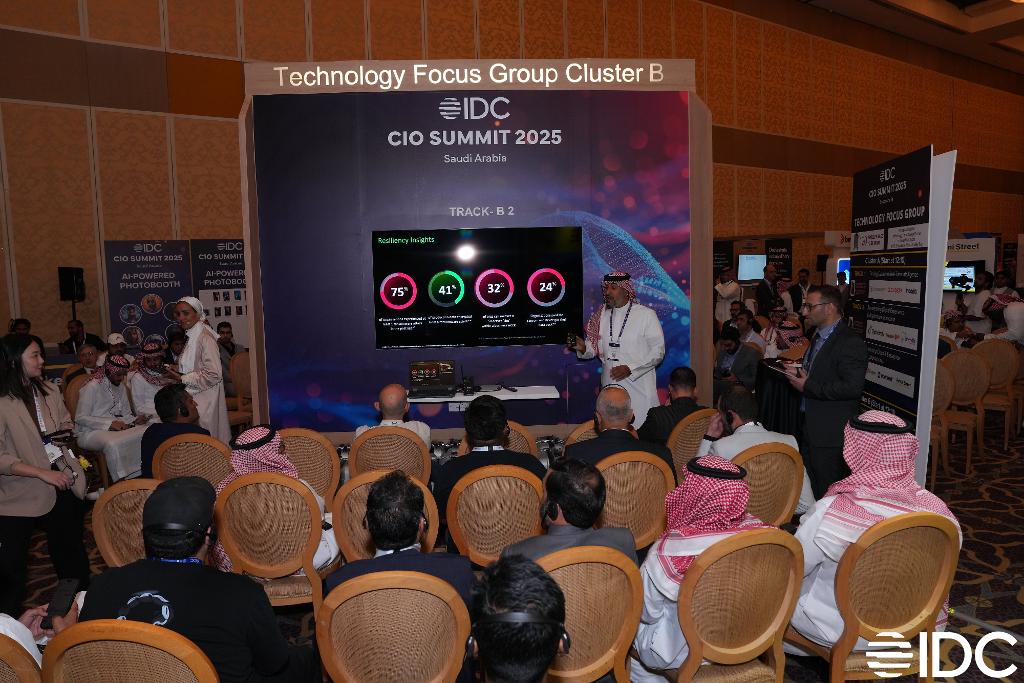
Saudi Arabia is in the midst of unprecedented national transformation, driven by ambitious Vision 2030 initiatives that aim to rapidly diversify the economy away from hydrocarbons. This has led to significant investments in giga projects such as NEOM, The Red Sea, Diriyah, and Roshn; mega sports events such as the Saudi Pro League, bids for the FIFA World Cup 2034 and the Winter Olympics 2030; and marquee global events such as World Expo 2030. In tandem, organizations in both the public and private sectors are undergoing transformation to upgrade their products, services, and operations to world-class levels.
Advanced technologies will underpin and enable these initiatives, leading to significant spending on applications, infrastructure, and cloud services. As the AI era unfolds, major investments are being made in AI and GenAI-enabled solutions including intelligence architecture, advanced big data analytics, next-gen intelligent automation, AIOps, and the convergence of AI with other technologies such as 5G connectivity, cloud, and IoT. Accordingly, IDC's META Digital Executive Survey revealed that 52% of organizations in Saudi Arabia are already prioritizing AI investments for the next 12 months, highlighting the substantial impact of AI in the country.
Networking with Industry Leaders: Engage with top decision-makers, thought leaders, and solution providers from across the region to expand your professional network.
Expert Guidance on AI Strategies: Learn from a stellar lineup of C-suite executives, thought leaders, and industry analysts who will share their expertise on building AI-led intelligence architectures.
Uncover New Business Models: Discover how AI is creating new opportunities for business innovation and how to adapt to an unpredictable business landscape.
Future-Proof Your Business: Stay ahead of the curve by understanding the long-term implications of AI on business strategy, helping your organization thrive in the digital economy.
Cloud as the Foundation for AI: Explore how cloud platforms are enabling scalable, secure, and agile AI deployments, supporting the next wave of AI-driven innovation.
Address AI-Related Security Challenges and Solutions: Understand the risks associated with AI adoption, including security concerns around data breaches, AI model integrity, and compliance issues, and explore mitigation strategies and explore how AI can enhance cybersecurity strategies, enabling proactive threat detection and response capabilities.
Discover AI-Driven Innovation and Implementations: Understand how organizations are adopting and leveraging generative AI (GenAI) to drive business transformation across industries. And, how to scale GenAI technologies across business processes and IT infrastructure, ensuring cost-effective and trusted real-world case studies of implementations.
Future-Proof Your Business: Stay ahead of the curve by understanding the long-term implications of AI on business strategy, helping your organization thrive in the digital economy.
IDC CIO Advisory Council 2025
H.E. Eng. Anas Al-Reemi
Vice Governor, Technologies & Solutions, Digital Government Authority
H.E. Khalid AlGhligah
Deputy Minister of Digital Transformation, Ministry of Sports
Eng. Naif Sheshah
Chief Digital Officer & Assistant Deputy Governor for Planning and Development, Communications, Space & Technology Commission (CST)
Sundah Alsehali
Chief of Digital Transformation, Public Sector
Nayef Bardeesi
Deputy Mayor, Digital Transformation, Holy Makkah Municipality
Dr. Eyad Buhulaiga
Chief Data & Digital Strategy Officer, Saudi Electricity Company (SEC)
Alessio Garofalo
Chief Information & Technology Officer, Oxagon, NEOM
Ramez AlFayez
CITO, King Abdullah Financial District
Dr. Abdulrahman Al Khnaifer
CIO, King Saud University (KSU)
Eng. Majed Mohammad Ayoub Alshodari
CIO, Ministry of Hajj and Umrah
Yazeed Abdullah Alotaibi
Deputy Minister for E-Health and Digital Transformation (KSA)
Jayesh Maganlal
Group Chief Information & Digital Officer, ROSHN Real Estate (KSA)
To compete and thrive in the new digital economy, progressive CIOs across the region are increasingly transforming their customer engagements, business operations, and operating models by leveraging digital technologies. They are rapidly adopting advanced technologies such as AI and leveraging cloud solutions to accelerate transformation. They are also supported by line-of-business leaders in delivering business transformation.
Through the IDC CIO Excellence Awards 2025, IDC intends to honor those organizations and IT leaders that have conceptualized and successfully delivered digital transformation initiatives that brought about tangible results.
At IDC, we pride ourselves on enforcing the very highest levels of transparency and impartiality. As such, each nomination will be reviewed and validated using a multi-tiered process.
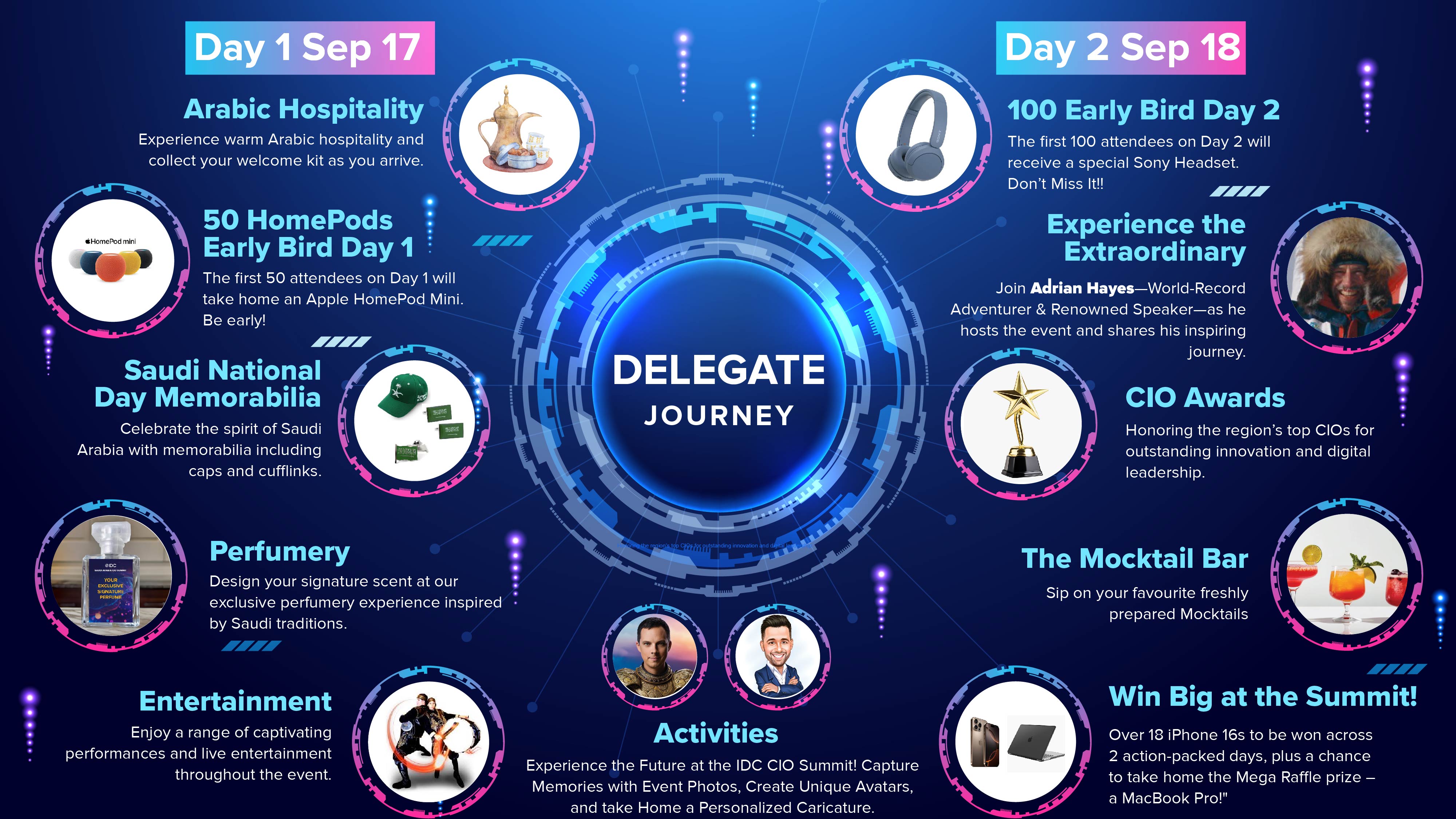
Registration & Networking Arrive early & Stand a chance to be among 50 winners of a Apple HomePod Mini!
8:30
Event Opening Battle of The Beats...Where Rhythm Meets Tech!
8:35
IDC Welcome Address
Jyoti Lalchandani
Head of WW Events & MD - META, Central Asia, India, IDC
8:45
IDC Opening Keynote: CIO Strategies for Thriving in the Agentic AI Era
As AI unleashes a wave of investment and innovation worldwide, Saudi Arabia is making significant moves to position itself as a global AI hub. Across industries, CIOs are building strategies for an AI-fueled business future. Generative AI, and now Agentic AI technologies, are already accelerating digital business transformation, and promise to have significant impact on digital innovation, customer experience and operational efficiencies. As they prepare their organizations for the Agentic AI era, CIOs need to develop critical capabilities around use case prioritization, AI governance, skills development, infrastructure for AI, and data-readiness. This session will provide Saudi CIOs with a playbook to help focus their efforts, address challenges, and unlock value from AI investments.
Ranjit Rajan
Vice President, Head of Research (META), IDC
9:10
From Vision to Velocity: Building the Intelligent Enterprise
As AI moves from hype to impact, enterprises must rethink their foundations to thrive in a data-driven era. In this opening keynote, Tareq Alangari, CEO of e& enterprise, will share his vision for how organizations can harness AI, powered by cloud and intelligent infrastructure, to accelerate innovation and competitiveness. He will explore the building blocks of AI readiness — strategy, culture, and technology — and how public-private collaboration is shaping the future of digital transformation in the Middle East. This session will set the tone for a day focused on actionable insights and strategic priorities for architecting truly intelligent, AI-fueled businesses.
Tareq Alangari
CEO, e& enterprise Saudi Arabia
Amine Chigani
Global Head of Enterprise Technologists, AWS
9:30
Driving Real Value from Generative AI: A Framework for CIOs and Business Leaders
Almost all analysts agree that while the majority of CEOs and government executives strongly believe in the potential of GenAI as a competitive advantage, they are not yet seeing that translate into real use cases for their business or institutions. This session will provide the UnifyApps point of view on the specific and tangible opportunities, solutions, and benefits.
Haitham Elkhatib
Co-Founder & Chief Revenue Officer, UnifyApps
9:50
Everything as a Service - The New Infrastructure Trends in the Kingdom of Saudi Arabia
Modern IT infrastructure in Saudi Arabia is being reshaped by “Everything as a Service.” This session highlights how XaaS enables organizations to become more agile, innovative, and growth-focused. Leaders will explore ways to leverage modern IT models to accelerate transformation, optimize resources, and drive strategic impact. Learn how adopting XaaS and infrastructure modernization aligns enterprises with Vision 2030, strengthens competitiveness, and unlocks long-term value.
Erick Baduy
CEO, Board Member, Founding Partner, Edarat Group
10:10
Building the AI-Ready Enterprise: Vision for Agentic Infrastructure
As AI continues to redefine the IT landscape, organizations must reimagine their infrastructure to thrive in the agentic era. This keynote will explore the latest innovations — such as AgenticOps, the AI Canvas, and advanced cloud control — that are transforming enterprise infrastructure from reactive to intelligent and secure. Discover how AI-optimized platforms spanning networking, security, and observability are empowering enterprises to operate at AI scale with greater confidence and control.
Tarik Alturki
Director, System Engineering, Cisco
10:30
From Vision to National Impact: AI, Orchestration and the Digital Future
Mamoun Masood
Regional Director, Saudi & Northern Gulf, Nintex
10:50
AI that Generates Human Value Outcomes: Full-Stack Innovation for Vision 2030
Join this session to explore how artificial intelligence is transforming industries — from marketing and IT operations to customer experience — delivering measurable efficiency gains and cost savings. With 90% of the world’s data created in just the past two years and AI projected to become a $407 billion market by 2027, the time to act is now. Discover how a full-stack AI approach can meet diverse needs across personal devices, private systems, and the cloud, enabling solutions that drive meaningful outcomes.
Dr. Mauro Arruda
Director, AI Solutions & Services, EMEA Leader, Lenovo
11:10
Fireside Chat: Sovereign AI at Scale – Accelerating the Kingdom’s AI Ambitions
As Saudi Arabia advances its national AI strategy, safeguarding data with secure, scalable infrastructure is essential. This session will explore how Oracle and NVIDIA are uniquely positioned to deliver hyperscaler-grade, sovereign AI infrastructure within the Kingdom. We will highlight how NVIDIA’s cutting-edge AI and accelerated computing technology, combined with Oracle Cloud’s in-country regions, high-performance networking, and compliance-ready architecture, come together to support this goal. Attendees will gain insights into how enterprises and government entities can safely and efficiently build, train, and deploy AI models without compromising data control or regulatory compliance. We’ll also share real-world examples and look ahead at how Oracle and NVIDIA’s joint innovations support Vision 2030’s goal of elevating Saudi Arabia’s role in the global AI ecosystem.
Mohamed Taha Benssiba
Vice President & Head of AI, Europe South, Middle East, & Africa, Oracle
Ahmed Mostafa
AI Ecosystems Adoption Lead (META), NVIDIA
11:30
Unleashing Efficiency: The Rapid Progression of IT Automation
Addressing the challenges organizations face in adopting and scaling automation initiatives while highlighting the opportunities presented by these technologies in driving digital transformation. This session delves into the transformative power of automation technologies, highlighting their pivotal role in driving efficiency, optimizing, workflows, and reshaping the future of work.
Mohammed Alobaid
VP, Products & Solutions, Salam
11:45
Advisory Council Felicitation
12:00
Tea / Coffee & Networking Break
12:10 13:25
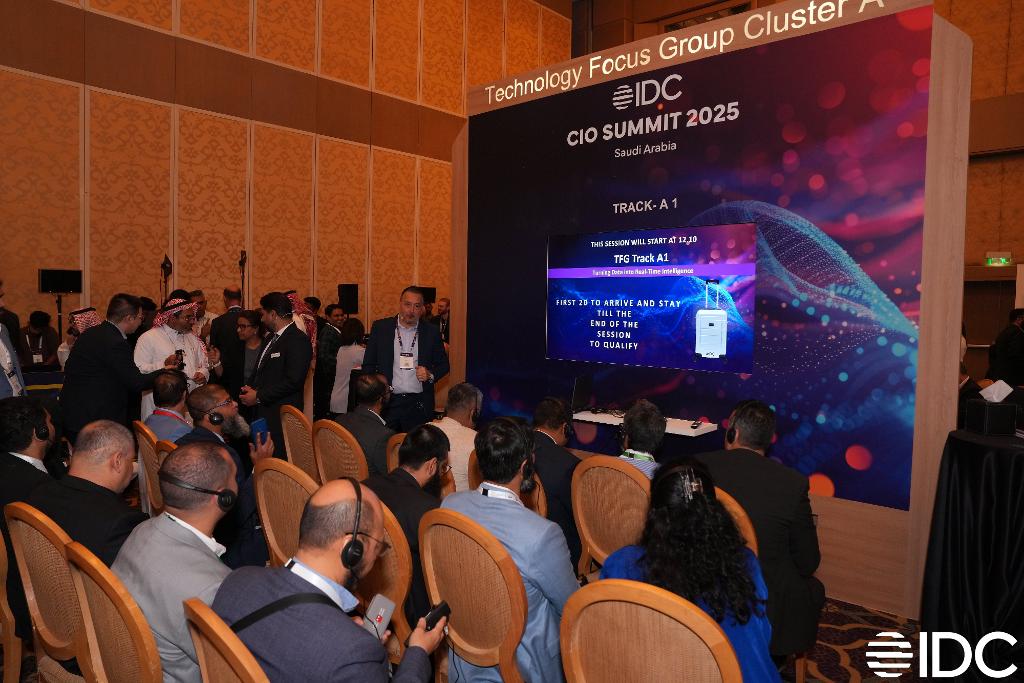
Technology Focus Group Tracks - Cluster A (Parallel Sessions)
Track A1: Turning Data into Real-Time Intelligence
12:10 - 12:15
Opening Act
12:15 - 12:18
Session Overview
Uzair Mujtaba
Senior Research Manager, IDC
12:18 - 12:20
Start of the Session Raffle
Attend the Track, Ask Questions, Rate Sessions & Stand a Chance to win iPhone 16
12:20 - 12:35
Supercharge Your AI Initiatives: Real-World Use Cases, Best Practices, and Essential Tools
With a focus on practical use cases and proven best practices, this session will explore how to accelerate your organization's AI initiatives. Learn how to leverage key tools and strategies to enhance AI projects, optimize workflows, and achieve better results.
Frederic Azar
Solution Architect, Cloudera
12:35 - 12:50
Unlocking the Value of AI with a Data Streaming Platform
To thrive in the evolving AI landscape, it is essential to steer clear of obstacles posed by outdated data-at-rest architectures. Organizations should construct a contemporary AI framework based on dynamic, real-time data. However, real-time AI requires trustworthy, relevant data served in the moment for smarter, faster insights. This is why data streaming is emerging as the fundamental infrastructure for the modern AI stack, enabling everyone to build powerful AI applications
Steve Fernandes
Senior Manager, Solutions Engineering, Confluent
12:50 - 13:05
AI with Guardrails: Enabling Regulatory Intelligence for Vision 2030
Saudi Arabia’s Vision 2030 is
accelerating AI adoption and digital transformation. Yet, in highly regulated
industries, success depends on doing AI with guardrails. Organizations must
balance rapid innovation with compliance requirements from NDMO, PDPL, and
sector regulators such as SAMA and NCA.
This session will explore how
enterprises can:
Align their data strategy with Vision 2030’s
transparency and innovation mandates.
Translate regulatory frameworks into auditable
data controls like lineage, catalog, classification, and quality.
Unlock AI-driven regulatory intelligence — anomaly
detection, risk modeling, natural language compliance queries — on top of
a unified operational lakehouse.
Learn from Saudi success stories
including Balady (MoH), the Ministry of Justice, and Neoleap, where
compliance and AI-driven insights have been enabled at scale.
Key takeaways:
How to embed NDMO and PDPL
compliance directly into your data foundation.
Reference architectures for AI-ready,
regulation-first data platforms.
Saudi case studies: Balady, the Ministry of
Justice, and Neoleap.
A 90-day road map to deliver AI with
guardrails at enterprise scale.
Hesham Mohamed
Strategic Senior Manager. Enterprise & Government Accounts, Incorta
13:05 - 13:20
Rebuilding Businesses for the Future: AI, Computer Vision, Robotics, and Digital Twins
13:20 - 13:25
Announcement of iPhone 16 Raffle Winner!
Track A2: Accelerating Digital Experience & Application Innovation
12:10 - 12:15
Opening Act
12:15 - 12:18
Session Overview
Mufasir Yousuf
Research Manager, IDC
12:18 - 12:20
Start of the Session Raffle
Attend the Track, Ask Questions, Rate Sessions & Stand a Chance to win iPhone 16
12:20 - 12:35
From Building Apps to Designing Intelligent Systems
The transition from traditional software development to low-code has already accelerated digital transformation, but the rise of artificial intelligence is reshaping the very foundations of software architecture. Mendix demonstrates how low-code is evolving from a productivity accelerator into an agentic platform that enables intelligent, adaptive, and integrated business systems. Generative AI augments the entire software development lifecycle, from requirements to deployment, while agentic AI embeds autonomy and orchestration into applications themselves. This shift transforms software from static solutions into dynamic participants within business ecosystems. Key architectural considerations such as trust, governance, and composability ensure that AI moves beyond isolated features to become an integral part of enterprise solutions. Low-code thus emerges as the foundation for businesses that are not merely AI-enabled, but truly AI-fueled.
Wilco Leenders
Lead Solution Architect Middle East, Mendix
12:35 - 12:50
Architecting for Outcomes: From Hype to ROI
In an era of unprecedented AI hype, businesses are grappling with a critical question: how do you move from impressive AI demos to a strategy that delivers tangible business value? This session will introduce a new paradigm for the Digital Experience Platform (DXP), one that is built to architect a truly AI-fueled business. We will explore how organizations can leverage AI not just to create, but to learn, adapt, and drive outcomes through a continuous loop of intelligent experimentation and real-time personalization. This approach emphasizes the critical need for validating and optimizing AI-driven experiences against key performance indicators like conversion, revenue, and customer lifetime value. For CIOs and business leaders, this is the blueprint for a future-proof technology stack that transforms customer interactions into strategic business assets.
Omar Sheliby
Regional Director, Optimizely
12:50 - 13:05
Reimagining Work: The Connected AI-Powered Enterprise
The way we work is being redefined. With 80% of companies investing in AI to transform their operating models, the challenge is no longer whether to adopt AI, but how to make it deliver a measurable impact. In this session, discover why AI matters and how it can be used to re-imagine work, creating a more connected, agile, and human-centered workplace. We’ll dive into practical ways to build, run, and orchestrate enterprise AI securely, so you can unlock productivity, elevate experiences, and prepare your workforce for the future.
Luuk Wösten
Senior Solution Consultant APAC and EMEA, Neptune Software
13:05 - 13:20
Smarter AI, Stronger Apps
13:20 - 13:25
Announcement of iPhone 16 Raffle Winner!
Track A3:Rethinking Cloud & Enterprise IT Modernization
12:10 - 12:15
Opening Act
12:15 - 12:18
Session Overview
Jawairia Asif
Senior Research Analyst
12:18 - 12:20
Start of the Session Raffle
Attend the Track, Ask Questions, Rate Sessions & Stand a Chance to win iPhone 16
12:20 - 12:35
From Bots to Brains: How Agentic AI Is Redefining Enterprise Intelligence
Over the past two decades, automation has transformed from simple task-based scripts into complex, intelligent ecosystems capable of self-directed decision-making. This session will trace the evolution from rule-based automation, through intelligent process automation, to the era of agentic AI — autonomous, goal-oriented AI systems that can plan, act, and adapt in dynamic environments. Attendees will explore how these capabilities are reshaping business models, augmenting human decision-making, and creating competitive advantage. The talk will highlight the strategic, technological, and governance considerations CIOs must address to adopt agentic AI responsibly and at scale.
Enas Ashraf
Senior Manager, Digital Evolution & Innovation, Crayon
12:35 - 12:50
Unifying the Intelligent Enterprise: An AI-Fueled Platform for End-to-End Agility
In today’s rapidly evolving digital landscape, organizations are seeking unified platforms that seamlessly integrate development, operations, service management, content services, and security. An AI-powered enterprise platform is redefining how businesses operate by bringing these critical domains together under one intelligent framework—fueling agility, resilience, and innovation.
This session explores how such platforms empower business users and IT teams alike to develop, test, monitor, and secure applications with greater autonomy and speed. By embedding AI across DevOps pipelines, observability tools, and enterprise service management workflows, organizations gain real-time insights, predictive capabilities, and enhanced governance.
Generative AI-powered conversational search further accelerates decision-making by enabling users to access, classify, summarize, and manage content intuitively. Security and compliance are strengthened through intelligent automation and proactive threat detection, ensuring that innovation doesn’t come at the cost of control.
Discover how the convergence of these capabilities within a single AI-fueled platform is helping enterprises unlock new ways of working—where every process is smarter, every decision is faster, and every user is empowered.
Karim Bounid
Director, Solution Consulting, OpenText
12:50 - 13:05
Fast AI Outcomes in Your ERP
AI can offer significant benefits for ERP systems, enabling simpler process automation, better decision-making, and improved user experiences. Should these AI capabilities be developed inside the ERP ecosystem using the vendor’s platform or outside, on the corporate data platform? Come to this session to learn about the intersection of AI and the back-office ERP and explore the trade-offs, costs, and ROI of different strategies for you to consider in your AI evolution. Uncover how to create an AI road map for your ERP system that maximizes business ROI and identify high-value use cases for AI, risks and common pitfalls, and strategies for maintaining agility in an ever-changing landscape.
Martyn Hoogakker
Group Vice President & Theatre General Manager, Rimini Street
13:05 - 13:15
Future-Proofing Employee Experiences: The AI Advantage
13:20 - 13:25
Announcement of iPhone 16 Raffle Winner!
12:11 13:25
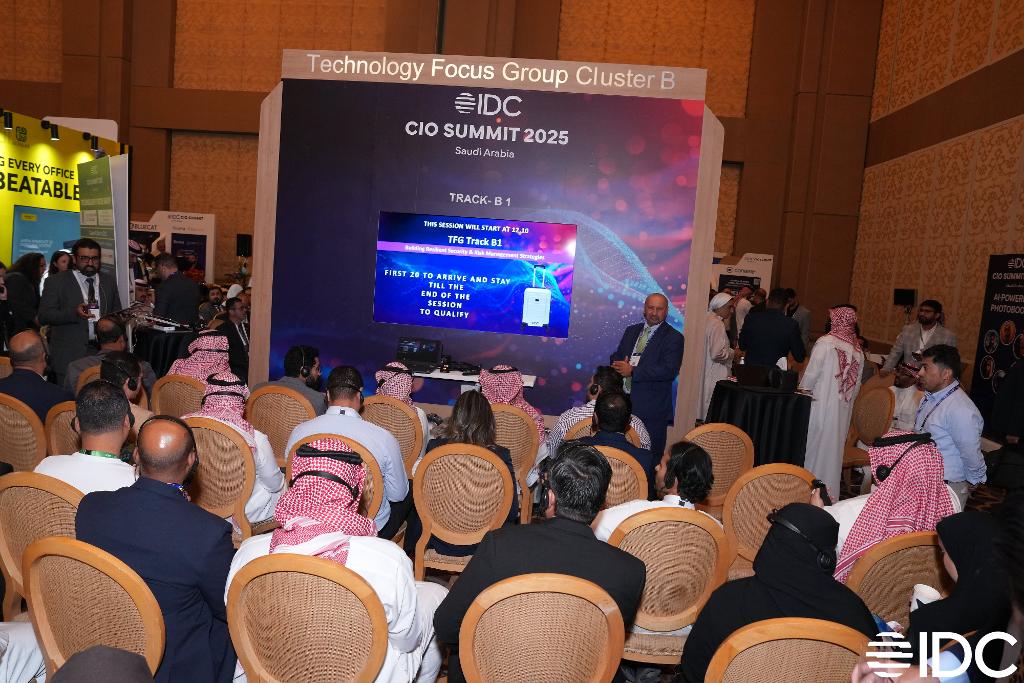
Technology Focus Group Tracks - Cluster B (Parallel Sessions)
Track B1: Building Resilient Security & Risk Management Strategies
12:10 - 12:15
Opening Act
12:15 - 12:18
Session Overview
Hyder Aftab
Research Manager, IDC
12:18 - 12:20
Start of the Session Raffle
Attend the Track, Ask Questions, Rate Sessions & Stand a Chance to win iPhone 16
12:20 - 12:35
Integrating a Risk-Based Approach into MSS
In today’s dynamic cyberthreat landscape, managed security services (MSS) can no longer rely on a one-size-fits-all model. Traditional MSS models often prioritize volume — alerting on everything, treating every incident as equal — leading to fatigue, inefficiency, and missed critical threats. A risk-based approach transforms this paradigm by shifting the focus from sheer detection to measured, prioritized protection.
By embedding risk into MSS, organizations align their security operations with business objectives. Threats are no longer viewed in isolation but evaluated against the context of business impact, critical assets, and regulatory obligations. This means not every alert warrants the same urgency: what matters most gets the highest priority, while noise is reduced through automation, context enrichment, and tailored playbooks.
For MSS providers, adopting this model creates strategic value. It enables them to deliver more than monitoring — it empowers them to act as true risk advisors. They can guide clients to make smarter investments, demonstrate measurable risk reduction, and align security outcomes with executive decision-making.
The integration journey requires three pillars:
Risk Identification and Mapping: Assessing assets, vulnerabilities, and threat exposure in business terms.
Prioritization and Contextualization: Leveraging frameworks like MITRE ATT&CK, threat intelligence, and compliance requirements to assign true business risk scores.
Operationalization in MSS: Embedding risk scoring into SOC workflows, reporting dashboards, SLAs, and incident response to ensure security operations deliver maximum impact.
Ultimately, integrating a risk-based approach into MSS is not just about better security — it’s about building trust, demonstrating business value, and ensuring resilience in a constantly evolving threat environment.
Muntaser Bdair
CEO, Security Matterz
12:35 - 12:50
The Cloud to Edge Continuum for AI Excellence
12:50 - 13:05
AI, Automation, and the Future of CIO Decision-Making
Naveed Yousuf
Consultant, Qualyn
13:05 - 13:20
Unlocking Peak Performance and Security for AI Apps: A Real-World Success Story
AI can offer significant benefits for ERP systems, enabling simpler process automation, better decision-making, and improved user experiences. Should these AI capabilities be developed inside the ERP ecosystem using the vendor’s platform or outside, on the corporate data platform? Come to this session to learn about the intersection of AI and the back-office ERP and explore the trade-offs, costs, and ROI of different strategies for you to consider in your AI evolution. Uncover how to create an AI road map for your ERP system that maximizes business ROI and identify high-value use cases for AI, risks and common pitfalls, and strategies for maintaining agility in an ever-changing landscape.
Raffaele D’Albenzio
Solution Architect Leader, F5
13:20 - 13:25
Announcement of iPhone 16 Raffle Winner!
Track B2: Ensuring Business Continuity with Data Protection & Resilience
12:10 - 12:15
Opening Act
12:15 - 12:18
Session Overview
Arif Sultan Shiekh
Senior Research Analyst, Software, IDC Saudi Arabia
12:18 - 12:20
Start of the Session Raffle
Attend the Track, Ask Questions, Rate Sessions & Stand a Chance to win iPhone 16
12:20 - 12:35
From Ransomware to Recovery: Building Unbreakable Data Resilience
In today’s aggressive cyber threat landscape, data protection isn’t just about backup—it’s a strategic imperative for CXOs. Veeam empowers organizations to protect their most vital asset—data—while enabling rapid recovery and continuous business operations, even in the face of sophisticated ransomware attacks.
Our approach centers on delivering "Zero Trust Data Resilience" through resilient data protection, AI-driven threat intelligence and detection, and automated orchestration. This holistic strategy minimizes costly downtime, mitigates reputational damage, and ensures compliance. With Veeam, CXOs can confidently drive digital transformation initiatives, knowing their business is resilient against any disruption.
Marwan AlHuthail
Senior Enterprise Sales Manager, Veeam Software
12:35 - 12:50
GenAI in the Enterprise: Shaping Smarter Workflows and Future-Ready Organizations
As enterprises race toward digitization, generative AI is redefining how we work, automate, and interact. It’s not just about faster processes — it’s about smarter decisions, intelligent content, and secure, human-centric experiences. This session will explore how GenAI is transforming the future of work, from automating document-heavy workflows to enabling real-time, personalized enterprise interactions. Through real-world examples, it will also show how organizations are being empowered to integrate GenAI securely within their digital platforms — bridging the gap between innovation and operational excellence. Join us to discover how your enterprise can harness GenAI not just to keep up — but to lead.
Mihalis Balonuskovs
Digital Solutions Architect (MENAT), Iron Mountain
12:50 - 13:05
Cyber Recovery & Resilience
Hamad Alawbathani
Account Director, Rubrik
13:05 - 13:20
Navigating the Edge: Overcoming Complexity in IoT and Edge Infrastructure
Start of the Session Raffle
Attend the Track, Ask Questions, Rate Sessions & Stand a Chance to win iPhone 16
12:20 - 12:25
Why AI Isn't a Silver Bullet: Beyond the Hype | Why It Won’t Work for You
Many believe AI simply "works." But true AI success hinges on more than just algorithms. This session will dissect the critical, often-overlooked foundations: your organizational culture, adaptable processes, and robust platforms. It will expose why ignoring these elements renders even the most advanced AI ineffective. Using Atlassian Intelligence as a prime example, this discussion will illustrate how a holistic approach, considering the human and operational layers, dictates whether AI genuinely transforms or simply complicates! Discover the true levers for AI adoption and impact.
Khalid Rabie
Head of Business Consultancy, Vidscola
12:35 - 12:50
Security, Simplicity, and Speed: Imperatives for Test Data Management in an AI-Fueled Business
Automated, efficient and secure data access will allow you to get ahead of your competition, regulators and your biggest security threats. This session will outline some fundamentals of handling very large core application datasets and provide examples of how to remove complexity and risk. Getting a handle on your most precious asset — customer data — drives benefits beyond the DevOps arena, improving business outcomes, operational resilience, delivery speed, and security. Whether your systems are entirely on-prem, in the public cloud, or across a hybrid infrastructure, ensuring fast and secure access to clean, current, and compliant data for your practitioners is vital — whether those practitioners are human or not.
Gary Hallam
Director, Channel Business, Delphix
12:50 - 13:05
AI-Human Harmony in CX: From Vision to Outcomes
AI-human harmony in CX is no longer an idea — it’s delivering real business outcomes today. This session will explore how organizations are putting AI-human harmony into practice to achieve:
Better Observability: Real-time visibility into conversations, quality, and compliance
Smarter Automation: Streamlining routine interactions while enabling agents to focus on high-value tasks
Deeper Personalization: Creating contextual, human-centric journeys across channels
By blending AI’s precision with human empathy, enterprises are reimagining CX for the next decade. This discussion will uncover why AI-human harmony is becoming the foundation of future-ready, human-centric customer experience.
Sachin Bhatia
Co-Founder & Chief Growth Officer,Exotel, Exotel
13:05 - 13:20
Building AI Centers of Excellence: A Global Perspective for the MEA Region
13:20 - 13:25
Announcement of iPhone 16 Raffle Winner!
13:25
Refresh & Reorganize
13:35
For the CIO by the CIO Redesigning Experience: How AI is Elevating Both Customer and Employee Journeys
As AI continues to evolve, its influence is no longer confined to customer-facing applications. This panel brings together CXOs from diverse industries to explore how AI is reshaping the entire experience ecosystem, bridging the gap between customer expectations and employee enablement. From intelligent automation and personalized engagement to smarter workflows and decision support, we’ll examine how AI is fostering more connected, responsive, and collaborative environments.
Dr. Aseel Addawood
KSA Lead, EMEA Artificial Intelligence Center of Excellence, Oracle
Dr. Abdulrahman Al Khnaifer
CIO, King Saud University (KSU)
Suliman Mohammad Khader
Group Chief Information Officer, Al Faisaliah Group
Filip Nekvinda
Chief Information and Digital Officer (CIDO), ALJ Enterprises
Dr. Muhammad Ehsan Khan
VP Data and AI, GO Telecom
Mohammed Belkhayatte
Chief Transformation Officer, Bindawood Group
14:05
For the CIO by the CIO Cross-Functional Collaboration in the Future Enterprise
Aligning IT strategies with line-of-business (LOB) strategies has become ever more critical to achieving business agility and resilience. In the age of AI everywhere, while advanced technology can accelerate business outcomes, frameworks for ensuring alignment with other functions on strategy, LOB needs, execution, expected outcomes, governance, risk management are crucial to business success. This session will explore how practices and operating models are evolving to enable greater alignment and collaboration between IT functions and other LOB functions like HR, finance, and operations.
Saeed Alzahrani
General Manager, Saudi Arabia, NetApp
H.E. Khalid AlGhligah
Deputy Minister of Digital Transformation, Ministry of Sports
Ahmad AlRifai
Group IT Director, Al Muhaidib Group
Mohannad AlSalmi
CIO, Flyadeal
Anas Mosa
IT Director, Government Entity
Dr. Manal Albawardi
Deputy Chief Information Officer, King Fahd University of Petroleum and Minerals (KFUPM)
14:35
Lunch & Close of Day 1
8:30
Registration & Networking Arrive Early & Stand a Chance to be among 100 Winners of a Sony Headphone!
8:55
IDC Welcome Address & Recap of Day 1
Jyoti Lalchandani
Head of WW Events & MD - META, Central Asia, India, IDC
9:00
The Cloud's Next Chapter: Intelligent Infrastructure for the AI Workload
The cloud is no longer a destination; it has become the launchpad for the next era of innovation. While the initial rush of adoption was often driven by compliance mandates — such as the MCIT's "Cloud First Strategy" and the DGA's goal to achieve 50% cloud adoption for digital government services by 2025 — the CIO's role has now evolved from managing costs to becoming a strategic leader for the entire business. The next great frontier is the integration of AI. This session will dive directly into the core challenge and opportunity: preparing your infrastructure for the AI revolution. It will explore what comes after the initial cloud adoption phase and discuss how CIOs must pivot from building a flexible, scalable cloud environment to architecting an intelligent infrastructure specifically designed to support the immense demands of AI and GenAI workloads. This isn't just about more computers; it's about a fundamental rethinking of data pipelines, network architectures, and security frameworks to enable AI at scale.
Sa'ed Tuffaha
Regional Director, Digital Innovation & AI, CNTXT
9:00
9:20
Bringing AI Everywhere: Unlock the Full Potential of AI
Ahmed Hussein
Senior Regional Manager, Solution Architects, Red Hat
Kareem Sherif
Director, AI & Datacenters, Intel
9:40
Bridging the AI Gap: Saudi Arabia’s AI Readiness & Maturity Journey
Saeed Al-Hadwan
Director, Data Analytics & AI, NourNet
Hamza Elfassi
Director, AI Services, OmniOps
10:00
Reinventing Data, Insights, and Action Amidst the Noise
AI is advancing at a pace that challenges even the most seasoned experts, offering immense potential but also significant uncertainty. This session outlines the most critical trends in AI and data, offering practical guidance to help data leaders make responsible choices today that will shape a more secure, impactful future.
Ted Orme
Field CTO Data Integration EMEA, Qlik
10:20
GenAI Meets Enterprise Low Code: A Strategic Pathway to Innovation
Generative AI (GenAI) and enterprise-grade low code are reshaping how organizations innovate. This session will showcase a strategic pathway to innovation that combines the speed and intelligence of GenAI with the scalability, security, and governance of low code. Learn how enterprises can modernize legacy systems, drive operational efficiency, and bring innovative ideas to market faster. Join us as we explore real-world examples of how organizations are using AI-powered capabilities to empower teams, streamline development, and create real impact while maintaining quality and control.
Mohamed Shaaban
Senior Account Executive, OutSystems
Gasser Abdullah
Head of Presales (Digital Solutions), Link Development
10:40 11:25
Summit Tracks (Parallel Sessions)
Summit Track A: Leveraging Data and AI for Customer and Operational Success
10:39 - 10:40
Session Overview
Paul Potgieter
Director, Technology & Digital Platforms, NEOM (UAE)
10:40 - 10:55
Data-Driven CX Transformation: Practical Pathways for Saudi Enterprises
This session will explore how businesses can turn customer data into results. It will explain how embracing practical strategies like building data foundations, connecting insights, and personalizing engagement can equip enterprises with clear takeaways to boost loyalty, improve efficiency, and drive growth.
Saran Babu
Regional Director, (MEA), Zoho Corporation
10:54 - 10:55
Ask Questions, Rate Sessions & Stand a Chance to win iPhone 16
10:55 - 11:10
Beyond Adoption: Building Intelligent Enterprises in the Age of AI
As Saudi organizations move beyond AI experimentation, the real challenge lies in building intelligent, adaptive, and scalable enterprises. This session explores the strategic leap from AI adoption to operationalized intelligence — where data, people, and platforms are orchestrated to think, learn, and act. Tarek Khattab will be sharing insights on how CIOs can lead this evolution by integrating AI into core business functions, embracing governance, and preparing for future technologies like AGI. With reference to IBM’s watsonx platform and Saudi’s national AI momentum, this talk will outline how to turn AI into lasting, intelligent transformation.
Tarek Khattab
Country Manager, Solutions & Services, SBM
11:09 - 11:10
Ask Questions, Rate Sessions & Stand a Chance to win iPhone 16
11:10 - 11:25
AI Agents & Innovation: Accelerating Saudi Arabia’s Digital Vision
Discover how AI agents and intelligent integration are enabling Saudi Arabia's Vision 2030 across both public and private sectors. This session will explore how AI-driven platforms accelerate digital innovation, streamline cloud transformation, and modernize customer and business services. Learn how the latest AI capabilities are helping organizations to break down data silos, orchestrate smarter operations, and establish agile foundations for sustainable growth as we share real-world insights into how leading Saudi enterprises are delivering customer-centric experiences, scaling digital ecosystems, and boosting operational efficiency. A must-attend session for CIOs and technology leaders aiming to harness emerging technologies in support of the Kingdom's ambitious digital transformation agenda.
Larbi Belbecir
Senior Solutions Consultant, Boomi
11:24 - 11:25
Ask Questions, Rate Sessions & Stand a Chance to win iPhone 16
Summit Track B: Strategies for Enabling an AI-powered Data-driven, Resilient, Sustainable Business
10:39 - 10:40
Session Overview
10:40 - 10:55
AI-Driven IT: A Strategic Imperative for Sustainable Business Performance
As organizations embrace AI, the success of these initiatives hinges on IT’s ability to deliver the performance, reliability, and scale required. In this session, we will explore how enterprises can shift from reactive IT operations to intelligent, AI-driven strategies that improve decision-making, reduce operational overhead, and unlock business impact. We will demonstrate how leading companies are aligning IT with core business outcomes - accelerating services, elevating user experiences, and building resilience into every layer of their digital operations.
Ask Questions, Rate Sessions & Stand a Chance to win iPhone 16
10:55 - 11:10
AI + Security + Connectivity: Powering the Next Generation of Enterprises
AI is reshaping enterprise operations — but it brings new security and connectivity challenges. This session will explore how the Connectivity Cloud combines AI-driven security and unified networking to help CIOs reduce complexity, protect critical assets, and scale AI initiatives with confidence.
Samer Hasan
Senior Strategic Solutions Engineer, Cloudflare
11:09 - 11:10
Ask Questions, Rate Sessions & Stand a Chance to win iPhone 16
11:10 - 11:25
High Return Enterprise GenAI
An AI that creates higher returns and competitive advantages for an enterprise should:
● Generate strategic insights rather than tactical responses.
● Engage meaningfully with decision makers instead of simply answering queries.
● Create measurable value by understanding and pursuing organizational purpose.
We found that the creation of such AI in the enterprise needs to be shaped by the following perspectives:
1. Teleology: What AI models should achieve ,
2. Epistemology: What counts as knowledge, and
3. Ontology: How AI represents reality
Without thoughtful and rigorous cultivation of such perspectives in the development of enterprise AI, organizations will fail to garner higher returns and competitive advantage from their generative and/or predictive AI investments, no matter how big these investments may be. In this session, we will take the audience on a tour de force of how we make the above perspectives indigenous to our Enterprise AI offerings"
Mohammed Ebrahim
Chief Data Scientist, Mozn
11:24 - 11:25
Ask Questions, Rate Sessions & Stand a Chance to win iPhone 16
11:25
Tea/ Coffee & Networking Break
11:35 12:20
Technology Focus Group Session - Cluster A (Parallel Sessions)
Track A1: Turning Data into Real-Time Intelligence
11:35 - 11:40
Opening Act
11:40 - 11:43
Session Overview
Uzair Mujtaba
Senior Research Manager, IDC
11:43 - 11:45
Start of the Session Raffle
Attend the Track, Ask Questions, Rate Sessions & Stand a Chance to win iPhone 16
11:45 - 12:00
Real time Intelligence
12:00 - 12:15
Beyond Printing: Complementary Business Communication Technologies
12:15 - 12:20
Announcement of iPhone 16 Raffle Winner!
Track A2: Accelerating Digital Experience & Application Innovation
11:35 - 11:40
Opening Act
11:40 - 11:43
Session Overview
Mufasir Yousuf
Research Manager, IDC
11:43 - 11:45
Start of the Session Raffle Attend the Track, Ask Questions, Rate Sessions & Stand a Chance to win iPhone 16
11:45 - 12:00
Smarter AI, Stronger Apps
AI and business applications are two sides of the same coin — one enables intelligence, while the other ensures scalability, efficiency, and enterprise-wide impact. This session explores how low-code/no-code (LCNC) bridges this gap, accelerating AI adoption while enhancing the agility and intelligence of business applications. It highlights how LCNC empowers enterprises to break down adoption barriers, drive real-time decision-making, and create a new wave of smarter, more connected, and high-ROI solutions.
Aly Hassballah
Director, Delivery & Solutions, CODE81
12:00 - 12:15
Winning Strategies for Multi-Cloud Environments
12:15 - 12:20
Announcement of iPhone 16 Raffle Winner!
Track A3: Rethinking Cloud & Enterprise IT Modernization
11:35 - 11:40
Opening Act
11:40 - 11:43
Session Overview
Jawairia Asif
Senior Research Analyst
11:43 - 11:45
Start of the Session Raffle Attend the Track, Ask Questions, Rate Sessions & Stand a Chance to win iPhone 16
11:45 - 12:00
Unlocking the Future with Agentic AI and Computer Vision
Avinash Hegde
Director -Operations, Godrej Infotech
12:00 - 12:15
IoT in Print Infrastructure: Revolutionizing the Office Ecosystem
12:15 - 12:20
Announcement of iPhone 16 Raffle Winner!
11:36 12:20
Technology Focus Group Session - Cluster B (Parallel Sessions)
Track B1: The Cloud Revolution: Foundation for Digital Business Transformation
11:35 - 11:40
Opening Act
11:40 - 11:43
Session Overview
Hyder Aftab
Research Manager, IDC
11:43 - 11:45
Start of the Session Raffle
Attend the Track, Ask Questions, Rate Sessions & Stand a Chance to win iPhone 16
11:45 - 12:00
Unleashing Innovation: Industry 4.0's Impact on Agile, Integrated Operations
12:00 - 12:15
Harnessing AIOps: Optimizing IT Performance and Efficiency
12:15 - 12:20
Announcement of iPhone 16 Raffle Winner!
Track B2: Powering Organizations with AI-Enabled Apps and Experiences
11:35 - 11:40
Opening Act
11:40 - 11:43
Session Overview
Arif Sultan Shiekh
Senior Research Analyst, Software, IDC Saudi Arabia
11:43 - 11:45
Start of the Session Raffle
Attend the Track, Ask Questions, Rate Sessions & Stand a Chance to win iPhone 16
11:45 - 12:00
Cyber-Resilience Journey Maps: Delivering Minimum Viability to the Business
Cyber resilience has become a business imperative, ensuring continuity even when disruption strikes. In this session, we will explore Cyber Resilience Journey Maps - a practical approach to identifying critical business priorities and aligning them with resilience strategies.
The discussion will highlight how organizations can define and deliver “minimum viable operations” to keep the business running during cyber incidents. We’ll also look at steps to assess current maturity, build a roadmap, and balance investment with risk.
Join us to discover how translating cyber resilience into business outcomes helps safeguard operations, reputation, and customer trust.
Mohammed Fayed
Presales Engineer, Commvault
12:00 - 12:15
Empowering the Future of Work: The Intelligent Digital Workspace
12:15 - 12:20
Announcement of iPhone 16 Raffle Winner!
Track B3: AI and Analytics: The Driving Forces of Digital Transformation
11:35 - 11:40
Opening Act
11:40 - 11:43
Session Overview
Dr. Eman Elshewy
Senior Research Manager, IDC
11:43 - 11:45
Start of the Session Raffle
Attend the Track, Ask Questions, Rate Sessions & Stand a Chance to win iPhone 16
11:45 - 12:00
The True Outcome of Digital Transformation: AI-Powered Ecosystem Platforms that Unlock Enterprise Value
Saudi Arabia’s Vision 2030 calls for bold digital innovation, new business models, and thriving ecosystems that diversify the economy. For enterprises, the journey begins with modernizing and transforming the core, legacy IT — simplifying, securing, and opening systems to become future ready. This session will demonstrate how AI-powered core transformation paves the way for digital ecosystem platforms that connect partners and customers, creating network effects. By evolving into ecosystem leaders, your enterprise can create new revenue streams, foster collaboration, and actively contribute to Vision 2030’s digital economy agenda. This session will outline practical steps to translate modernization into new growth avenues and platform-led innovation for the Kingdom.
Wafa Alqahtani
Business Growth & Innovation Partner, Torry Harris
12:00 - 12:15
Crafting a Hybrid Work Model: Navigating Policy and Technology
Analyst Spotlight The AI Everywhere Era in the Public Sector
Massimiliano Claps, Research Director, IDC
AI and GenAI are having an increasingly pervasive impact on government — across missions, use cases, processes, and systems — in the Middle East and beyond. The disruptive impact of these technologies, compounded by geopolitical volatility, technical debt, digital sovereignty concerns, elevated citizen expectations, and regulatory changes, will require government leaders to approach innovation holistically. The acquisition and implementation of new technologies will not be enough. Realizing the benefits of AI, cloud, and industry platforms will require revisiting governance, risk management, culture, and the building of competencies to accelerate innovation.
Analyst Spotlight Enabling AI Outcomes with Cybersecurity
Frank Dickson, Group Vice President, Security & Trust, IDC
GenAI was coming. Predictive AI was coming. No . . . wait, it was already here. Anyway, we sit here today focused on the art and the genuineness of the possible.
As we consider and dream of the possible, we sometimes forget the reality of the now. Between the hype around GenAI and the COVID-19 pandemic before that, we sometimes fail to acknowledge that cybersecurity has grown up. Once the dominion of hoodie-wearing basement dwellers, the topic has elevated to the C-suite and beyond. Attacks from the cyberthreat landscape do not just present a technical risk — the ramifications create a risk to the organization itself. In essence, cyber risk equals business risk.
CXO Spotlight AI in Defense: Automated Threat Detection
Nasser AlGhamdi, GM of Cybersecurity, Saudi Commission for Health Specialties
AI is changing the way we stay safe on the internet. One thing many companies and individuals have been using historically is a list of known threats, but the hackers would not stay still. They would rename the code, switch servers, and find gaps in our security — and I’ve seen too many companies get left behind. But what they have missed is that this is AI’s real power; machine learning can identify undesirable behavior before serious damage is done. For instance, if an account suddenly logs in at midnight or downloads files it never uses, we can immediately stop it and address the problem before the hackers get the company’s data or overrun the system.
Analyst Spotlight Architecting the Future of Enterprise Applications: The AI-Cloud Convergence
Uzair Mujtaba, Senior Research Manager, IDC
Saudi Arabia’s digital economy is entering a crucial phase. As Vision 2030 accelerates nationwide transformation, CIOs across industries are reimagining their enterprise application stacks, and the conversation is quickly shifting from cloud migration to building an intelligent, adaptive, and autonomous application ecosystem powered by AI, generative AI (GenAI), and the next frontier, agentic AI.
IDC’s latest research indicates that nearly 42% of CIOs are already running AI-native and AI-enhanced applications in production with established training and acquisition plans. Driven by operational efficiency and customer centricity priorities, this shift comes with its own set of challenges. Legacy ERP environments, fragmented data pipelines, and skills shortages are testing the resilience of transformation strategies.
Partner Spotlight The Rise of AI Agents Signals the Growing Importance of Data Privacy
Data privacy is becoming increasingly complex and critical as organizations turn to AI to revamp their operations and processes. Among these advancements is agentic AI, designed to autonomously execute tasks without human intervention and act with agency.
For all its benefits, Agentic AI’s reliance on vast amounts of personally identifiable data raises significant privacy concerns and fuels growing consumer mistrust in how organizations manage personal information. According to a recent Cloudera Agentic AI survey, data privacy tops the concerns of respondents with 53% citing it as the main barrier. This has the potential to worsen when agentic AI hits the mainstream adoption phase in critical sectors like healthcare and financial services where personal data is prized at a premium.
Partner Spotlight Rethinking Leadership for the Middle East’s AI-Powered Future
Khalid Rabie, Head of Business Consultancy and Executive Coach and Trainer, Vidscola
From hype to sustained impact, enterprises must blend human insight, ethical rigor, and agile culture to unlock AI’s true value.
Across the Gulf, sovereign visions and business ambitions have positioned AI as the next growth engine. Yet leadership teams discover that algorithms alone cannot redesign an organization; they simply expose its strengths and bottlenecks. Navigating this revolution therefore begins with organizational development — clarifying decision rights, shortening feedback loops, and empowering multidisciplinary squads that can learn as fast as models evolve.
Partner Spotlight From Exploration to Execution: The AI Inflection Point
Hussein Ragy, Chief Executive Officer, BBI
For years, we’ve witnessed organizations explore artificial intelligence with cautious curiosity — running pilots, testing use cases, and evaluating proof of concepts. Yet, we are no longer in the era of exploration. Today, we are firmly stepping into the execution phase of AI.
Across industries — whether public sector or private enterprises — the shift is clear. Leaders are no longer asking, “What can AI do for us?” Instead, they are asking, “How do we implement AI now and what value will it deliver?” At BBI, this shift resonates deeply with our journey. Since 2009, we have remained focused solely on data and AI solutions, and today, our strength in execution is what drives results for our clients.
Partner Spotlight Pioneering Cloud, AI, and Datacenter Solutions in Riyadh
Edarat Group
Digital transformation across the Middle East is no longer a future goal; it is today’s business imperative. Cloud computing, AI, and datacenter modernization are at the heart of this change, enabling organizations to innovate at speed, scale efficiently, and meet national digital ambitions such as Saudi Arabia’s Vision 2030. Cloud platforms are evolving from basic infrastructure to strategic enablers of agility and resilience, while AI is being deployed to automate workflows, enhance customer experiences, and unlock insights from complex datasets. Together, these technologies are reshaping industries from finance and healthcare to energy and government.
Partner Spotlight Navigating AI and Data Privacy: Key Considerations for CIOs
CIOs today face the dual challenge of driving innovation through artificial intelligence (AI) while upholding stringent data privacy standards. The rapid proliferation of AI across business operations introduces new complexities, especially as sensitive data increasingly fuels development, analytics, and automation. To remain competitive and compliant, CIOs must strategically address the intersection of adopting AI and protecting data privacy.
Partner Spotlight Unlocking the Power of GenAI for Service Innovation
In today’s enterprise landscape, the conversation around generative AI (GenAI) is shifting from hype to tangible impact. Organizations are asking not just whether to adopt AI, but how to integrate it in ways that enhance services, deliver measurable value, and maintain operational control.
At the IDC Saudi Arabia CIO Summit 2025, the theme “Unlocking the Power of Gen AI: Enhancing Services Through Innovation” reflects both the challenges and opportunities facing leaders in the Kingdom’s public and private sectors. The rapid evolution of AI capabilities around predictive analytics, natural language interfaces, process automation, and generative content has opened doors to new service models and customer experiences. Yet, these advances also raise critical questions around governance, data integration, and ethical use.
Partner Spotlight Minimum Viable Company: The New Go-To Strategy for Modern Cyber Resilience
Sameh Hassan, Country Manager, Saudi Arabia, Commvault
Cyberattacks are becoming more frequent, more sophisticated, and more critical, and organizations need to think beyond conventional recovery models. That said, being able to recover after the damage is not enough. The focus must shift to sustaining operations during a crisis.
This is where the concept of the minimum viable company (MVC) becomes invaluable. MVC has been defined as “the smallest possible version of an organization that can still function and serve customers should an incident bring down part(s) of the operations and systems.” It’s a pragmatic approach through which to view continuity.
Partner Spotlight AI in 2025 and Beyond: Authenticity, Action, and Autonomy Will Define Success
Ted Orme, Field CTO Data Integration EMEA, Qlik
As artificial intelligence continues to accelerate, 2025 has proven to be a turning point, prompting organizations to rethink how they use data, automation, and insights to deliver business impact. While the promise of AI is vast, so are the risks. Staying competitive now demands not only speed, but also clarity and responsibility.
With AI-generated content now making up more than half of what we see online, trust in digital information is increasingly under pressure. The risk of generative models learning from unreliable or fabricated data is real. To address this, organizations are investing in data integrity and emphasizing the importance of verifiable sources, provenance tracking, and initiatives like AI Trust Scores. Unlocking the potential of previously untapped “dark data” and embracing interoperable platforms is also helping build confidence in AI outcomes.
Partner Spotlight Artificial Intelligence: No Longer a Futuristic Concept
Mo Mobasseri, CEO, emt
Artificial intelligence is no longer a futuristic concept; it has become the driving force behind business transformation across industries. In Saudi Arabia, where Vision 2030 is reshaping the economic landscape, organizations are at the crossroads of opportunity: to architect businesses that are not only AI-enabled, but AI-fueled at their very core.
Partner Spotlight From Digital Native to AI Native: The Next Five Years
We’ve seen this movie before. In the 1990s, enterprises either rebuilt for the web or bolted on a browser layer and hoped for the best. The winners rewrote. The same pattern is unfolding now — with AI. Only this time, the change will be faster, deeper, and more unforgiving.
In our new Enterprise Roadmap for AI Nativity white paper, we outline what it takes to move beyond pilots and become truly AI native.
Partner Spotlight State of Application Strategy 2025: Misalignment Means Mediocrity
Lori MacVittie, Distinguished Engineer, F5
As we move through 2025, the pressure to deliver faster, more secure, and efficient applications is intense. Yet complexity, legacy practices, and misalignment keep undermining AI’s full potential. To stay competitive, organizations must align their strategies across security, automation, and deployment. This was one of the key themes in our latest State of Application Strategy report. Below are some of the main takeaways.
Partner Spotlight Building an AI-Fueled Business in the Middle East
Dr. Ahmed Alhusayni, Medad SaaS & Cybersecurity Manager, Naseej for Technology
At a time when artificial intelligence is becoming a major driver of innovation, businesses in the Middle East are working hard to create AI-powered companies that can succeed in the future. The potential of AI is huge. Globally, the technology is expected to contribute $19.9 trillion to the economy by 2030. In the Middle East, AI could boost the regional economy by around $320 billion, which is about 11% of GDP, by 2030. These figures highlight why nearly 72% of organizations in the region are already using or planning to use AI. From finance and healthcare to oil & gas and education, companies are rethinking their services and operations through an AI-focused perspective to stay competitive in this rapidly changing landscape.
Partner Spotlight IT Sustainability in the Age of AI: Navigating the Rising Environmental Costs of Innovation
Yahya Bakir, Sales Director (KSA & Bahrain), Evernex
The Paradox of Progress
AI is transforming industries, from manufacturing and cybersecurity to communications. Its benefits are clear — as is the threat of falling behind. However, this transformation comes with a high cost to the planet. As companies accelerate their adoption of AI, they must also address their environmental impact and ensure their practices align with evolving sustainability standards and industrial compliance.
Partner Spotlight AI at Work: Empowering Business Users with OpenText Aviator
As organizations across the Kingdom accelerate their digital transformation journeys, the IDC Saudi Arabia CIO Summit 2025 presents a timely opportunity to explore how AI is reshaping the future of business. Under the theme “Architecting the AI-Fueled Business,” OpenText is proud to spotlight how its innovative Aviator AI platform is helping enterprises break new limits, ushering in a new era of intelligent, autonomous operations.
Partner Spotlight Unlock Network Efficiency with Intelligent Operations
Roger Holder, DipM, MCIM, Senior Manager, Field & Partner Marketing EMEA, BlueCat
Why the future of network management is proactive, predictive, and intelligent
Are You Still Firefighting?
If your network team spends more time reacting to incidents than driving strategy, you’re not alone. According to the DDI Maturity Report from Enterprise Management Associates, 52% of enterprises struggle with DDI complexity. And that complexity isn’t slowing down. Hybrid architectures, multicloud adoption, and AI-driven workloads are pushing traditional network operations to breaking point.
Analyst Spotlight Enabling Digital Transformation in Saudi Arabia Through Policy and Regulation
Tolga Yalcin, Research Director, IDC
Following the shift from traditional telecom regulation to ICT regulation in the first two decades of this century, the current decade has seen a move toward digital regulations. This shift is driven by the growing adoption of technologies such as cloud, IoT, and AI across both consumers and businesses.
The Communications, Space, and Technology Commission (CST) has created an enabling regulatory environment with tailored frameworks for cloud, IoT, and digital content platforms. It has also introduced wholesale and competition measures for critical digital infrastructure, including FTTx, 5G, and datacenters. According to the ITU’s Digital Regulatory Maturity Index, the CST has achieved the highest level of organizational maturity (Level 5), ranking first in the Middle East and Africa and ninth among the G20 countries.
Partner Spotlight Modernization to Monetization: How CIOs Orchestrate Ecosystem Growth with AI
Karthik TS, Head of Technology, Torry Harris Integration Solutions
From Digitization to Monetization: The next frontier is about turning core assets — data, APIs, and services — into products that drive new revenue.
AI as a Business Driver: AI is shaping offerings, bundles, and partnerships across the ecosystem, moving beyond efficiency to create shared value.
Ecosystem Leadership — An Advantage: No enterprise can realize the Vision 2030 goals on its own — it takes collaboration. CIOs who master the orchestration of partners, start-ups, and peers will own the platforms that define tomorrow’s markets
Saudi Arabia’s rails are laid for platform plays1: over 97% of government services are digitized2, and the Kingdom ranks among the world’s most advanced in digital government. Meanwhile, boards are chasing AI revenue and partner-led growth as the digital transformation market races from $10.9 billion in 2024 toward $82 billion by 2033 (23%+ CAGR)3. Further, 93% of organizations in KSA have an AI strategy in place or under development4 — meaning your competitors are already wiring AI into products, processes, and partner ecosystems.
Partner Spotlight AI Is Redefining the Job of Your Website
The role of an enterprise website is undergoing a profound shift. For years, its primary purpose was to attract visitors, deliver information, and drive conversions. But today, we are witnessing a structural change in how people discover and consume information with AI, one that is reshaping the very job your website performs. If you’re a CIO or head of digital experience, this shift affects your road map today.
Your new audience doesn’t click; it crawls.
In just one year, human website traffic has declined by 10–30% year over year across industries. It’s like someone walked into your store, asked a question, got the answer, and left, without ever opening the door. This isn’t a sign of failure. It’s a signal that your website’s function has changed. Your site no longer serves just a single audience. It now has two equally critical constituencies: humans and AI agents.
Analyst Spotlight AI Is Redefining the Job of Your Website
Hyder Aftab, Research Manager, IDC
The telecommunications sector is undergoing a profound transformation, driven by advances in next-generation connectivity, cybersecurity, and AI integration. IDC’s 2025 insights position Saudi Arabia as a regional leader in network modernization, with enterprises adopting innovative technologies and dedicating investments aligned to emerging business priorities.
Telecommunications networks are now foundational enablers at the intersection of cybersecurity and AI, delivering secure, resilient infrastructures essential for innovation and competitive differentiation. These networks embed security at every layer, supporting critical AI-driven digital services. Enterprises increasingly prioritize security and operational agility over traditional connectivity metrics, illustrating a fundamental market shift.
Analyst Spotlight "Next-Gen Networks”: Inflexion point to Re-Wire for the AI Era underpinned by Cloud
Wilson Xavier, Senior Research Director, ICT Services, META, IDC
Global and Regional AI Spend and Adoption Trends
AI investment is accelerating, with worldwide annual Artificial Intelligence IT spending is projected to hit $1.3 Trillion by 2029, as per the latest IDC forecast. The Middle East, particularly Saudi Arabia and the UAE, leads in rapid enterprise AI adoption, fueled by aggressive national strategies and demand for smarter resilient supply chains. Governments and organizations in META are prioritizing AI competitiveness through initiatives like AI hubs, datacenters, local language models, and enabling regulatory frameworks. and integrating AI into public sector digital transformation projects. Initiatives like OpenAI's Stargate UAE project and Saudi Arabia's "Humain" initiative are driving the development of AI datacenters and multimodal language models.
Partner Spotlight AI-Human Harmony: The Future of Customer Engagement
Customer engagement is undergoing a profound shift. For years, enterprises relied on a simple formula: automation to scale, humans to empathize. That balance held until customer expectations changed. Today, people want to be recognized and understood instantly, across every channel, with experiences that feel intelligent and human at the same time. Incremental improvements will not meet this demand. What is needed is a complete redesign of how intelligence powers every interaction.
The answer is AI-human harmony, an operating principle where artificial intelligence and human expertise work as one. This is not about replacing people with machines or layering AI onto outdated workflows. It is about creating a living model of engagement where machines bring continuous learning, precision, and scale, while humans provide empathy, judgment, and trust. Together, they form an adaptive, resilient fabric that strengthens with every interaction.
Partner Spotlight How AI Agents Are Impacting API Management
Organizations today use an average of 275 cloud applications — and large enterprises use even more. This rapid SaaS expansion often goes hand in hand with shadow IT, resulting in increased costs, security risks, and data silos.
A centralized API management approach can help organizations get a handle on this sprawl, but also creates more challenges in the form of undocumented APIs, security gaps, and governance silos. Agentic AI is quickly emerging as a solution to the complexities of API management.
Partner Spotlight The Digital Backbone of Tomorrow's Cities: Why Enterprise Asset Management Is the Unsung Hero of Transformative Projects
As we bear witness to some of the most ambitious urban development projects of our generation in the Kingdom of Saudi Arabia, a critical question arises: how do we ensure these marvels of human achievement don't become monuments to operational inefficiency? The answer lies in a technology that rarely makes headlines, yet fundamentally underpins long-term success — enterprise asset management (EAM).
When we talk about projects that redefine cityscapes and create entirely new ecosystems, we're discussing assets worth billions, infrastructure spanning thousands of square kilometers, and operational complexities that would overwhelm traditional management approaches. This is where EAM transforms from supporting technology to strategic imperative.
Partner Spotlight High-Return Enterprise AI: Rethinking Value Creation in the Age of Intelligence
Mohammed Ebrahim, Chief Data Scientist, Mozn
As Saudi Arabia accelerates its digital transformation, the role of the CIO is rapidly evolving. It is no longer enough to deliver operational efficiency alone; today, leaders are expected to unlock new strategic value and build a sustainable competitive advantage. In this environment, enterprise AI stands out as a powerful tool. Yet its full potential often goes untapped when it is viewed only as a tactical solution for automation or data processing.
Partner Spotlight AI-Driven IT: A Strategic Imperative for Sustainable Business Performance
“Sustainable performance” isn’t about a single quarter’s uptick. It’s the ability to deliver consistent, high-quality outcomes year after year, even as customer expectations, regulatory demands, and technology stacks evolve. It’s this pressure that makes AI-driven IT foundational to business resilience.
Partner Spotlight From Vision to Velocity: Building the Intelligent Enterprise in Saudi Arabia
Tareq Alangari, CEO, e& enterprise Saudi Arabia Amine Chigani, Global Head of Enterprise Technologists, AWS
Saudi Arabia is undergoing one of the most ambitious digital transformations in the world. Guided by Vision 2030, the Kingdom has invested heavily in building world-class digital infrastructure, with the digital economy expected to nearly double its share of GDP by 2030. This momentum places Saudi Arabia among the fastest-growing digital economies in the Middle East.
Yet ambition alone does not deliver results. The challenge for organizations lies in execution — turning strategy into measurable, business-wide impact. This is where the concept of the “intelligent enterprise” becomes vital. By embedding cloud, data, and artificial intelligence across every function, enterprises can shift from digital vision to tangible outcomes such as faster decision-making, greater efficiency, and stronger trust.
Partner Spotlight How AI Is Revolutionizing Software Development: A Complete Guide to the Future
Gasser Abdullah, Head of Presales (Digital Solutions), Link Development Mohamed Shaaban, Senior Account Executive, OutSystems
The AI-Driven Development Revolution
Software development as we know it is being completely transformed. Traditional coding methods that once took weeks are now completed in hours. AI-powered development tools are enabling every organization to operate like a tech company, accelerating innovation and time-to-market while maintaining enterprise-grade security and compliance. Imagine a world where developers focus on creative problem-solving instead of repetitive tasks, where legacy systems modernize themselves, and where high-quality applications deploy faster than ever before. This transformation is happening now. Here's everything you need to know about AI-driven software development and how to implement it successfully.
Generative AI: Speeding Up the Cycle
Generative AI has already reshaped how developers work. By turning natural language prompts into code snippets, it accelerates routine coding tasks and reduces development time. Beyond code generation, it creates standardized templates, detailed user stories and comprehensive test cases. It can even draft documentation and user guides, freeing developers to focus on problem-solving and innovation.
Contact Us
Ronita Bhattacharjee
Vice President - Conferences, IDC Middle East, Africa, & Turkey
Held in more than 30 countries, they foster networking, collaboration, engagement, and knowledge sharing among industry leaders and professionals. Each event is meticulously curated to provide valuable insights and meaningful connections through analysts and editor-led content, global perspectives, case studies presented by the world’s leading tech companies and a range of interactive formats including expert panels, live demos, roundtables, 1:1 meetings and workshops.
Partner Spotlight How AI Is Revolutionizing Software Development: A Complete Guide to the Future
Gasser Abdullah, Head of Presales (Digital Solutions), Link Development Mohamed Haaban, Senior Account Executive, OutSystems The AI-Driven Development Revolution
Software development as we know it is being completely transformed. Traditional coding methods that once took weeks are now completed in hours. AI-powered development tools are enabling every organization to operate like a tech company, accelerating innovation and time-to-market while maintaining enterprise-grade security and compliance. Imagine a world where developers focus on creative problem-solving instead of repetitive tasks, where legacy systems modernize themselves, and where high-quality applications deploy faster than ever before. This transformation is happening now. Here's everything you need to know about AI-driven software development and how to implement it successfully.
Generative AI: Speeding Up the Cycle Generative AI has already reshaped how developers work. By turning natural language prompts into code snippets, it accelerates routine coding tasks and reduces development time. Beyond code generation, it creates standardized templates, detailed user stories and comprehensive test cases. It can even draft documentation and user guides, freeing developers to focus on problem-solving and innovation. Agentic AI: Beyond Automation While generative AI improves efficiency, agentic AI goes further. Agentic AI consists of purpose-built intelligent agents capable of autonomous action, collaborating with each other, making decisions, and executing tasks. These agents act like team members, with reasoning and planning capabilities that allow them to generate, check, edit, and optimize code. Specialized agents support tasks such as translating legacy code into modern languages, detecting security vulnerabilities, and optimizing performance. This shift enables organizations to tackle long-standing technical debt and accelerate modernization efforts, achieving outcomes that were previously too costly or complex. What once took weeks can now be achieved in hours, redirecting developer efforts toward higher-value, creative work.
The Role of Low Code While developers are embracing AI-powered application generation (AppGen) and experimenting with agents, enterprise leaders are understandably concerned about their impact on an already fragmented technical landscape and unpredictable outcomes for stakeholders and customers. This is where low-code platforms can play a critical role in AI-driven development. Low-code platforms combining security guardrails, governance, and full life-cycle management with AppGen and agents give development teams a safe, interpretable, and sustainable path to enterprise-scale innovation.
This approach ensures that AI-generated code adheres to enterprise standards, reducing risks associated with autonomous AI coding. It also empowers teams with varying technical expertise to participate in development, democratizing innovation while maintaining control over architecture, compliance, and performance.
Embracing the AI-Driven Future The convergence of generative AI, agentic AI, and low-code platforms represents more than technological advancement — it's a fundamental shift in how software gets built. Organizations that embrace this transformation will: ● Accelerate innovation cycles ● Reduce development costs significantly ● Improve software quality through automation ● Enable broader participation in development ● Focus talent on high-value activities
At the same time, this shift reshapes the developers’ role. They will work alongside AI agents that automate repetitive tasks, orchestrate workflows and ensure compliance, allowing them to focus on strategic initiatives while evolving into key partners to the business. AI-powered AppGen on a robust low-code platform unlocks the best of both worlds: high-quality, enterprise-grade applications delivered with speed and reliability — a balance standalone AI or code-centric tools cannot achieve. The key to success lies in choosing approaches that integrate automation with built-in governance, security, and scalability frameworks. The future of software development is here — and it’s powered by AI. As these technologies continue evolving, the organizations that invest in AI-driven development today will lead tomorrow's digital landscape.
Partner Spotlight From Vision to Velocity: Building the Intelligent Enterprise in Saudi Arabia
Tareq Alangari, CEO, e& enterprise Saudi Arabia Amine Chigani, Global Head of Enterprise Technologists, AWS
Saudi Arabia is undergoing one of the most ambitious digital transformations in the world. Guided by Vision 2030, the Kingdom has invested heavily in building world-class digital infrastructure, with the digital economy expected to nearly double its share of GDP by 2030. This momentum places Saudi Arabia among the fastest-growing digital economies in the Middle East.
Yet ambition alone does not deliver results. The challenge for organizations lies in execution — turning strategy into measurable, business-wide impact. This is where the concept of the “intelligent enterprise” becomes vital. By embedding cloud, data, and artificial intelligence across every function, enterprises can shift from digital vision to tangible outcomes such as faster decision-making, greater efficiency, and stronger trust.
Several technologies are at the heart of this transformation. Cloud computing provides the foundation for agility and sovereignty, ensuring organizations can innovate securely and at scale. Artificial intelligence, forecast to contribute significant economic value to the Kingdom by 2030, is already driving predictive insights and reshaping industries. Meanwhile, 5G is enabling new possibilities for IoT, automation, and connected services. Still, technology alone is not enough — secure, high-quality, and well-governed data remains the true differentiator for scaling innovation responsibly.
Execution at speed requires more than tools. Leadership commitment, robust governance, and security by design are critical enablers. Trust has become the currency of transformation, and with cybersecurity investments rising, organizations are ensuring that innovation moves forward responsibly.
Equally important is the human dimension. An enterprise becomes intelligent not through systems alone, but through people and culture. Digital fluency, a mindset of continuous learning, and the preservation of creativity, empathy, and ethics will ensure that human judgment remains central alongside AI and automation.
Finally, no enterprise can achieve this journey in isolation. Collaboration between governments, regulators, industry players, and academia is essential to accelerate innovation and build sustainable, sovereign digital ecosystems.By 2030, being an intelligent enterprise will no longer be a differentiator — it will be the default. The foundations are already being laid today for organizations in Saudi Arabia to be cloud native, AI driven, globally competitive, and trusted locally.
Partner Spotlight AI-Driven IT: A Strategic Imperative for Sustainable Business Performance
“Sustainable performance” isn’t about a single quarter’s uptick. It’s the ability to deliver consistent, high-quality outcomes year after year, even as customer expectations, regulatory demands, and technology stacks evolve. It’s this pressure that makes AI-driven IT foundational to business resilience.
The starting point is data. Most organizations are swimming in telemetry but short on truth. AI changes this by turning data from networks, clouds, applications, databases, and endpoints into context-rich insight. Instead of reacting to incidents, teams gain early warning on degradations, capacity risks, and experience dips, preventing issues before they reach customers. That shift from hindsight to foresight is the bedrock of reliable performance.
Measurement matters. You can’t measure what you can’t see. High-fidelity observability, enriched by machine learning, empowers organizations to track the metrics that move the business. This evidence-based approach underpins credible reporting to the board and regulators, while also informing continuous optimization.
Resource optimization is the next lever as a more efficient IT environment is inherently a more effective one. With the aid of AI, IT teams can effectively identify inefficiencies such as underused infrastructure, redundant tools, and idle licenses. By automating right-sizing, workload placement, and life-cycle clean-up, they can unlock capacity, trim spend, and reduce complexity. Eliminating these inefficiencies also curbs complexity, allowing infrastructure to stay agile over the long term.
Crucially, observability must be treated as a framework, not a feature. When insight spans SaaS, IaaS, PaaS, applications, data tiers, end-user experience, and devices, AI can correlate symptoms to causes and recommend targeted remediation. Yet tools alone are not enough. Many teams lack the bandwidth or skills to interpret signals and translate them into business impact. Here, AI and automation play a pivotal role, summarizing root causes, proposing fixes, and orchestrating changes through low-code runbooks so IT teams can focus on more strategic initiatives — what we at Riverbed call “Shift Left.”
Organizations that embed AI into the fabric of IT operations don’t merely run more reliably. They adapt faster, innovate with confidence and meet rising expectations without spiraling costs. In short, AI-driven IT is how enterprises turn operational excellence into a sustained competitive advantage.
Partner Spotlight High-Return Enterprise AI: Rethinking Value Creation in the Age of Intelligence
Mohammed Ebrahim, Chief Data Scientist, Mozn
As Saudi Arabia accelerates its digital transformation, the role of the CIO is rapidly evolving. It is no longer enough to deliver operational efficiency alone; today, leaders are expected to unlock new strategic value and build a sustainable competitive advantage. In this environment, enterprise AI stands out as a powerful tool. Yet its full potential often goes untapped when it is viewed only as a tactical solution for automation or data processing.
To truly drive impact, AI must be designed to support smarter decision-making, foster meaningful dialogue among leaders, and remain aligned with the organization’s long-term vision. This shift requires rethinking how AI is conceived, implemented, and integrated into enterprise strategies. Rather than treating AI as a set of features, it should be built with purpose, grounded in knowledge that is actionable, and designed to reflect the realities of organizational structures, cultural contexts, and regulatory environments.
Without this deeper approach, even the most advanced AI risks creating a gap between technological capability and business impact. Systems may process data on a scale but still fail to address the strategic needs of the enterprise. The difference lies in cultivating AI that not only works efficiently but also adapts to context, drives relevant insights, and delivers outcomes that matter.
CIOs in Saudi Arabia are uniquely positioned to lead this transformation. With access to cutting-edge technologies and a strong national mandate for innovation, they have both the tools and the responsibility to shape AI strategies that create real value. As the IDC CIO Summit brings together regional technology leaders, the conversation must move beyond simple adoption. The future of enterprise intelligence lies not in generic platforms, but in systems that understand, adapt, and lead — turning AI into a true driver of growth and transformation.
Partner Spotlight The Digital Backbone of Tomorrow's Cities: Why Enterprise Asset Management Is the Unsung Hero of Transformative Projects
As we bear witness to some of the most ambitious urban development projects of our generation in the Kingdom of Saudi Arabia, a critical question arises: how do we ensure these marvels of human achievement don't become monuments to operational inefficiency? The answer lies in a technology that rarely makes headlines, yet fundamentally underpins long-term success — enterprise asset management (EAM).
When we talk about projects that redefine cityscapes and create entirely new ecosystems, we're discussing assets worth billions, infrastructure spanning thousands of square kilometers, and operational complexities that would overwhelm traditional management approaches. This is where EAM transforms from supporting technology to strategic imperative.
Modern EAM systems, particularly when integrated with advanced performance management (APM) tools, provide something far more valuable than maintenance schedules. They offer:
• Predictive intelligence that anticipates failures before they occur • Lifecycle visibility across diverse asset portfolios • Performance optimization through data-driven decision-making • Risk mitigation in environments where operational continuity is non-negotiable
In these transformative environments, EAM becomes the digital command center — the single source of truth that coordinates everything from critical infrastructure maintenance to facility operations. It's the technological backbone that ensures:
• Seamless integration of smart building systems • Real-time monitoring of energy consumption and sustainability metrics • Automated compliance with increasingly complex regulatory requirements • Optimized resource allocation across massive operational footprints
Moreover, APM tools also play a huge role in this. In a way they are the game changer. APM tools elevate EAM from reactive maintenance to proactive optimization. They enable:
• Condition-based monitoring that moves beyond scheduled maintenance • Performance benchmarking against industry standards and project objectives • Predictive analytics that transform operational data into strategic insights • Integration capabilities with IoT ecosystems and smart infrastructure
Therefore, from the C-suite, the value proposition is clear: EAM and APM tools provide the visibility, control, and predictability needed to manage billion-dollar investments effectively. They transform capital projects from construction achievements into operational successes.
As for measuring success, the ROI extends far beyond maintenance cost reductions. It’s all about:
• Extended asset lifespans in demanding environments • Enhanced safety records through predictive risk management • Operational efficiency gains that compound over decades • Sustainability achievements through optimized resource utilization
Over time, as these projects evolve, the integration of EAM with digital twin technology, AI-driven analytics, and IoT ecosystems will create operational environments that are not just efficient, but truly intelligent.
Conclusion
In the grand narrative of transformative urban development, EAM may not be the star of the show, but it's undoubtedly the director ensuring everything performs perfectly night after night, year after year. For leaders steering these monumental projects, it's not just another system — it's the foundation upon which operational excellence is built.
Partner Spotlight How AI Agents Are Impacting API Management
Organizations today use an average of 275 cloud applications — and large enterprises use even more. This rapid SaaS expansion often goes hand in hand with shadow IT, resulting in increased costs, security risks, and data silos.
A centralized API management approach can help organizations get a handle on this sprawl, but also creates more challenges in the form of undocumented APIs, security gaps, and governance silos. Agentic AI is quickly emerging as a solution to the complexities of API management.
The Role of AI in API Management
AI-powered API management is revolutionizing documentation, security, and developer experiences while solving API sprawl challenges. AI agents can automate routine tasks, enhance security, and provide insights into API performance, ultimately improving operational efficiency. Key potential areas of benefit include:
● API Documentation: AI can automatically generate and maintain accurate API documentation, ensuring it stays current with evolving APIs. This reduces development time and security vulnerabilities. ● Developer Experience: AI simplifies API integration by providing intelligent assistance, suggesting APIs, generating code, and creating test cases. This accelerates development timelines and reduces the learning curve for new APIs. ● Security and Governance: AI enhances API security by offering real-time monitoring and alerts for potential threats. It helps organizations maintain compliance with regulations and ensures consistent security policies across all APIs. ● Traffic Management: AI improves traffic management by analyzing usage patterns and dynamically adjusting resources. This ensures optimal performance during traffic spikes and reduces downtime.
Addressing API Sprawl and Data Quality
As organizations adopt more APIs, they face challenges like redundancy, security issues, and difficulty getting the right data to the right place when it’s needed. AI agents can help by:
• Discovering and cataloging existing APIs • Identifying redundant APIs for consolidation • Monitoring usage for optimization opportunities
But it’s not just a one-way street. Even the most sophisticated AI systems need high-quality data to deliver accurate, meaningful results. While AI is transforming API management, APIs are enabling AI integration — providing the connectivity among data sources, secure data transfer, and real-time access to information that businesses need for success. Well-designed APIs can streamline AI implementations and reduce complexity.
Developing an AI-Driven API Strategy
To prepare for AI-driven API management, organizations should: 1. Establish Strong API Governance: Create clear policies and standards for API design and management. 2. Invest in API Discovery: Implement comprehensive API discovery and create a centralized catalog of APIs. 3. Adopt AI-Ready Design Practices: Design APIs with clarity and comprehensive metadata to maximize AI interaction. 4. Leverage a Unified Management Platform: Use a comprehensive platform that integrates API management with broader integration capabilities.
The shift is already delivering measurable outcomes. Contact centers using real-time agent guidance and automation report 30% higher productivity and 25% faster resolution times. AI-led self-service is cutting routine call volumes by up to 30%, while improving containment and satisfaction. Enterprises adopting observability are seeing 15% gains in CSAT, driven by early friction detection and greater transparency. These results show that early adopters are already unlocking tangible business value. At the core of this transformation are three pillars that make this a practical reality:
Continuous Learning → Personalized Journeys Personalization is evolving from static campaigns to real-time learning, where every touchpoint improves the next.
Intelligent Orchestration → Frictionless Operations Automation is advancing from routine execution to orchestrating complex journeys, freeing humans for high-value conversations.
Observability → Trust at Scale Engagement is no longer a black box. Enterprises now gain real-time visibility into reliability, compliance, and sentiment, ensuring fairness, transparency, and accountability.
Together, these pillars establish a new operating model for engagement: self-learning, self-optimizing, and trustworthy by design. Instead of fragmented tools and siloed processes, enterprises gain a unified ecosystem that evolves in step with customers. The outcome is experiences that are relevant, reliable, and consistently human.
Together, these pillars establish a new operating model for engagement: self-learning, self-optimizing, and trustworthy by design. Instead of fragmented tools and siloed processes, enterprises gain a unified ecosystem that evolves in step with customers. The outcome is experiences that are relevant, reliable, and consistently human.
Analyst Spotlight "Next-Gen Networks”: Inflexion point to Re-Wire for the AI Era underpinned by Cloud
Wilson Xavier, Senior Research Director, ICT Services, META, IDC
Global and Regional AI Spend and Adoption Trends
AI investment is accelerating, with worldwide annual Artificial Intelligence IT spending is projected to hit $1.3 Trillion by 2029, as per the latest IDC forecast. The Middle East, particularly Saudi Arabia and the UAE, leads in rapid enterprise AI adoption, fueled by aggressive national strategies and demand for smarter resilient supply chains. Governments and organizations in META are prioritizing AI competitiveness through initiatives like AI hubs, datacenters, local language models, and enabling regulatory frameworks. and integrating AI into public sector digital transformation projects. Initiatives like OpenAI's Stargate UAE project and Saudi Arabia's "Humain" initiative are driving the development of AI datacenters and multimodal language models.
Convergence of AI and Cloud: A Catalyst for Continuous Transformation and implications for Networks
AI and cloud computing are evolving together, with AI enhancing cloud-native systems and cloud serving as the foundation for AI capabilities. In this broad context, enterprises perceive AI as the driver of value, while cloud provides the platform to enable AI adoption. This mutually cascading catalyst effect is leading to accelerating AI adoption and influencing cloud strategies by re-setting pace for modernizing applications and driving hybrid/multi-cloud adoption. In the META region, fueled by investments of Hyperscalers and National Cloud providers– focus on Data Sovereignty and Governance are being prioritized by organizations across vertical sectors such as Government, Healthcare, Telecom, and Finance to address compliance requirements with local regulations and ensuring data security when adopting AI solutions. As per IDC Research, 34% of META organizations are planning to adopt AI solutions on the cloud platform over the next twelve months. These advances create exponential growth in data volume and require networks optimized for performance and security.
Trusted Network Foundations: Architectural Evaluation of Network Strategy in tandem with AI and Cloud adoption
Modern AI deployments rely on resilient, ultra-low-latency networks to process context-rich data in real time. Robust network infrastructure—including SDWAN, network security, cloud connect networks, SASE, and Network as a Service (NaaS)—is thereby essential for META CIOs to consider in order to successfully adopt and deliver AI-enabled services. These technologies form the backbone for modern digital transformation, unlocking operational efficiencies, scalability, and greater business value in the age of AI.
Software Defined Network architectures like SDWAN solutions automate traffic routing and bandwidth allocation, ensuring critical AI workloads get the best path for speed and consistency. For CIOs, robust SDWAN facilitates scalable, cloud-connected digital ecosystems needed to deliver services such as predictive analytics, automation, and digital customer experiences. Similarly, Cloud Connect networks and NaaS enable “Network Instance” construct for agile, on-demand infrastructure, scalable and context-aware for AI workloads. They enhance organizational agility, reduce operational complexity, and lower costs—outcomes crucial for multi-site enterprises driving digital transformation projects. In Parallel (On the other hand…), AI-driven network automation ensures that connections adapt dynamically, boosting performance and reducing latency across applications and services.
Security framework for AI on Network layer brings a critical dimension to consider as AI-powered applications introducing complex cyber risks, making network security and SASE pivotal. Security-first networks leverage AI and Zero Trust principles to actively monitor and contain threats, protect sensitive data, and mitigate breaches before they impact operations. SASE converges networking and security in a unified cloud-native solution, delivering secure, seamless connectivity for distributed teams, multi-cloud environments, and hybrid workplaces.Interestingly, as per IDC META Region Research latest Insights, 66% of the CIOs in the region are looking at Strategic Focus on Networking Investments moving forward, which exemplifies the realization of this outlook.
Strategic Impact and Leadership Considerations for META region & KSA CIOs
For META and KSA CIOs, envisioning and evaluating next-generation networking architectures like —SDWAN, SASE, cloud connect networks, and NaaS—are foundational to AI success. CIOs must champion next-generation networking technologies and foster cross-functional collaboration, positioning their organizations to lead in digital transformation and extract maximum value from Cloud and AI investments.
Analyst Spotlight AI Is Redefining the Job of Your Website
Hyder Aftab, Research Manager, IDC
The telecommunications sector is undergoing a profound transformation, driven by advances in next-generation connectivity, cybersecurity, and AI integration. IDC’s 2025 insights position Saudi Arabia as a regional leader in network modernization, with enterprises adopting innovative technologies and dedicating investments aligned to emerging business priorities.
Telecommunications networks are now foundational enablers at the intersection of cybersecurity and AI, delivering secure, resilient infrastructures essential for innovation and competitive differentiation. These networks embed security at every layer, supporting critical AI-driven digital services. Enterprises increasingly prioritize security and operational agility over traditional connectivity metrics, illustrating a fundamental market shift.
Saudi Arabia exemplifies this evolution with a clear trend toward flexible network services. A majority of enterprises recognize the growing importance of solutions like SD-WAN and SASE, alongside cloud connectivity and fixed wireless access. These dynamic signals the Kingdom’s leadership in the META region’s push for agile, secure digital infrastructure.
Investment priorities clearly reflect a security-first and agility-driven mindset. Nearly half or more organizations emphasize enhancing security, resilience, and flexibility. Notably, improving connectivity with external partners is a growing focus area, highlighting the importance of ecosystem integration.
In communication platforms, maturity varies. Cloud-based unified communications are on par with traditional on-premises deployments, while contact center modernization presents an untapped opportunity with a sizeable portion of legacy systems still in use.Despite progress, challenges around budget constraints, regulatory compliance, and skills shortages remain. However, most enterprises pursue bold strategic transformation goals rather than simply maintaining operational continuity.For CIOs guiding digital transformation, these insights underscore critical imperatives: architecting security-enabled, agile networks that support AI innovation; prioritizing scalable cloud and edge solutions; and enhancing partner ecosystem connectivity. Addressing workforce development and compliance from the outset will mitigate risks and accelerate gains. Modernizing contact centers and adopting cloud UCaaS further unlock operational and customer experience improvements.
In sum, Saudi Arabia’s rapid digital infrastructure evolution offers CIOs a unique opportunity to align their strategies with Vision 2030 ambitions and the shifting ICT landscape. By focusing investments on secure, flexible, and integrated network services, organizations can build a resilient foundation for sustainable growth in an AI-driven economy.
Partner Spotlight AI Is Redefining the Job of Your Website
The role of an enterprise website is undergoing a profound shift. For years, its primary purpose was to attract visitors, deliver information, and drive conversions. But today, we are witnessing a structural change in how people discover and consume information with AI, one that is reshaping the very job your website performs. If you’re a CIO or head of digital experience, this shift affects your road map today.
Your new audience doesn’t click; it crawls.
In just one year, human website traffic has declined by 10–30% year over year across industries. It’s like someone walked into your store, asked a question, got the answer, and left, without ever opening the door. This isn’t a sign of failure. It’s a signal that your website’s function has changed. Your site no longer serves just a single audience. It now has two equally critical constituencies: humans and AI agents.
For humans, the website remains a validation layer and an experience hub. People still turn to websites to confirm credibility, immerse themselves in branded storytelling, or complete complex workflows — things AI interfaces can’t fully replicate, like applying for a loan or configuring an enterprise solution.
For AI, the website has become a data source. Large language models (LLMs) are crawling, extracting, and summarizing your content continuously. Increasingly, they deliver answers directly to users, without ever sending traffic back to your site. This “invisible traffic,” untraceable in your analytics, creates a new strategic imperative: generative engine optimization (GEO).
SEO helps you rank in search. GEO helps you show up in answers.
Where SEO was about ranking on search results pages, GEO is about ensuring your content is authoritative, structured, and trusted enough to be embedded in AI-generated responses. Meeting this challenge requires more than marketing tweaks. It demands a rethinking of your digital infrastructure. Your CMS isn’t just a content tool. It’s your content supply chain. A single source of truth designed to feed both human-facing channels and AI engines. This composable approach reduces risk, lowers total cost of ownership, and increases agility by ensuring content flows seamlessly across websites, apps, and AI-driven ecosystems.
The mandate is clear: architect for AI. That means designing content and systems the way AI consumes them — structured, concise, reliable — while still delivering compelling human experiences. Organizations that optimize for both audiences will not only remain visible but gain influence in the AI-driven economy.
Partner Spotlight Modernization to Monetization: How CIOs Orchestrate Ecosystem Growth with AI
Karthik TS, Head of Technology, Torry Harris Integration Solutions
From Digitization to Monetization: The next frontier is about turning core assets — data, APIs, and services — into products that drive new revenue.
AI as a Business Driver: AI is shaping offerings, bundles, and partnerships across the ecosystem, moving beyond efficiency to create shared value.
Ecosystem Leadership — An Advantage: No enterprise can realize the Vision 2030 goals on its own — it takes collaboration. CIOs who master the orchestration of partners, start-ups, and peers will own the platforms that define tomorrow’s markets
Saudi Arabia’s rails are laid for platform plays1: over 97% of government services are digitized2, and the Kingdom ranks among the world’s most advanced in digital government. Meanwhile, boards are chasing AI revenue and partner-led growth as the digital transformation market races from $10.9 billion in 2024 toward $82 billion by 2033 (23%+ CAGR)3. Further, 93% of organizations in KSA have an AI strategy in place or under development4 — meaning your competitors are already wiring AI into products, processes, and partner ecosystems.
Modernization & Beyond: Turning Tech into Trade.
The next phase of value in Vision 2030 may not come from “projects that digitize” but from platforms that monetize — specifically, ecosystem platforms and marketplaces, built on strong integration foundations, that productize your capabilities (APIs, data, services) and let partners compose them into outcomes. The CIO mandate is to make this commercially safe and technically simple:
Monetize the core, not just modernize it. Treat modernization as productization: surface a small set of revenue-ready capabilities with contractable SLAs, pricing, and telemetry, underpinned by integration that makes them consumable across business units and partners, and with intelligence embedded so each capability improves over time
Operationalize AI where value transacts. Embed AI in the partner life cycle across onboarding, scoring, bundling, and pricing so that each new partner increases margin instead of operational load.
Engineer for ecosystem scale. Build integration-first architectures, governance, and observability that let APIs, data, and services scale safely across multiple partners and markets, ensuring interoperability, resilience, and compliance without linear cost.
The P&L Playbook for CIOs
In our experience, CIOs who own platform P&L are looking for a de-risked path to first ecosystem revenue. This usually manifests in the form of:
a) An integration fabric that connects legacy estates, cloud services, and partner APIs so everything else is composable and revenue ready
b) A 90-day blueprint to stand up 2–3 monetizable bundles, identifying the APIs, data sets, or services to productize first
c) A partner contract kit (legal, risk, incentives)
d) A run-time governance model (data/AI, observability, chargeback)
The market is already moving in this direction, and with KSA’s ecosystem momentum accelerating, the window of opportunity is short. Success will come less from scale and more from the speed at which partners are orchestrated into revenue.
Analyst Spotlight Enabling Digital Transformation in Saudi Arabia Through Policy and Regulation
Tolga Yalcin, Research Director, IDC
Following the shift from traditional telecom regulation to ICT regulation in the first two decades of this century, the current decade has seen a move toward digital regulations. This shift is driven by the growing adoption of technologies such as cloud, IoT, and AI across both consumers and businesses.
The Communications, Space, and Technology Commission (CST) has created an enabling regulatory environment with tailored frameworks for cloud, IoT, and digital content platforms. It has also introduced wholesale and competition measures for critical digital infrastructure, including FTTx, 5G, and datacenters. According to the ITU’s Digital Regulatory Maturity Index, the CST has achieved the highest level of organizational maturity (Level 5), ranking first in the Middle East and Africa and ninth among the G20 countries.
At the same time, the Saudi Data and AI Authority (SDAIA) and National Cybersecurity Authority (NCA) have been established to position the Kingdom as a global leader in an elite league of data-driven economies by implementing a data and AI agenda at the national level and strengthening cybersecurity in the Kingdom to mitigate risks, boost trust, and enable growth.
Today, collaborative regulation is more important than ever. Given the rapid digital transformation underway across vertical sectors in the Kingdom, coordination is not only required among digital regulators such as the CST, SDAIA, and NCA, but also with sector-specific policymakers, including the Ministries of Health, Sports, and Finance, as well as the Saudi Central Bank.
Partner Spotlight Unlock Network Efficiency with Intelligent Operations
Roger Holder, DipM, MCIM, Senior Manager, Field & Partner Marketing EMEA, BlueCat
Why the future of network management is proactive, predictive, and intelligent
Are You Still Firefighting?
If your network team spends more time reacting to incidents than driving strategy, you’re not alone. According to the DDI Maturity Report from Enterprise Management Associates, 52% of enterprises struggle with DDI complexity.
And that complexity isn’t slowing down. Hybrid architectures, multicloud adoption, and AI-driven workloads are pushing traditional network operations to breaking point.
The Silent Threat: Network Complexity
Today’s networks are:
• Distributed across on-premises and multiple cloud providers • Managed by disparate tools with limited integration • Dependent on manual workflows and institutional knowledge
The risks? Hidden misconfigurations, slow resolution times, compliance gaps, and outages that ripple across the business.
Complexity isn’t just an operational headache — it’s a business risk.
Why Intelligent Network Operations Changes the Game
Imagine a network that tells you when something’s about to break — and fixes itself before it does.
Intelligent network operations embeds automation, diagnostics, and real-time analytics into the heart of your infrastructure. The result? A shift from reactive firefighting to proactive problem prevention.
The core capabilities:
• Continuous monitoring for real-time health insights • Automated anomaly and misconfiguration detection • Root cause analysis with guided remediation steps • Virtual expertise that extends the reach of your team
From Firefighting to Foresight
When organizations embrace intelligent network operations, they see measurable gains:
• Faster resolution: Automation slashes downtime and mean time to recovery (MTTR) • Greater resilience: Early warnings catch issues before they escalate • Unified visibility: A single operational view across hybrid and multicloud environments • Smarter decisions: Data-driven insights guide resource allocation and troubleshooting
One IT team in financial services uncovered a replication failure they didn’t even know existed — avoiding a service outage that would have cost millions.
The “Before and After” Effect
Before:
• Incidents escalate before detection • Monitoring tools are disconnected and incomplete • Recovery depends on the right person being available at the right time
After:
• Proactive detection and automated remediation • Centralized visibility across all environments • Self-healing capabilities that scale with network demands
Why this Matters Now
The pace of change in network environments isn’t slowing. Cloud adoption, SD-WAN deployments, and AI workloads are reshaping performance requirements. Without intelligent operations, keeping up will require more people, more budget, and more risk tolerance than most organizations can afford.
The Bottom Line
Intelligent network operations isn’t about replacing teams — it’s about empowering them. By giving IT the tools to see, predict, and resolve problems before they impact users, organizations unlock agility, resilience, and operational clarity.
In the next era of IT, the winners won’t be those who respond fastest to outages. They’ll be the ones who prevent them altogether.
Partner Spotlight AI at Work: Empowering Business Users with OpenText Aviator
As organizations across the Kingdom accelerate their digital transformation journeys, the IDC Saudi Arabia CIO Summit 2025 presents a timely opportunity to explore how AI is reshaping the future of business. Under the theme “Architecting the AI-Fueled Business,” OpenText is proud to spotlight how its innovative Aviator AI platform is helping enterprises break new limits, ushering in a new era of intelligent, autonomous operations.
In today’s fast-paced digital landscape, business users are increasingly seeking agility, autonomy, and control over their information and applications. OpenText Aviator delivers on this promise by empowering users to securely manage and govern their data, while dramatically reducing reliance on traditional IT processes. From development and testing to deployment and monitoring, Aviator enables a self-service model that puts the power of AI directly into the hands of business teams.
This shift is not just about efficiency; it’s about elevating human potential. By embedding AI into the core of enterprise workflows, OpenText Aviator helps organizations unlock new ways of working. Whether it’s automating content classification, enhancing decision-making with predictive insights, or streamlining compliance and security, OpenText Aviator transforms how information is used and understood across industries.
For CIOs and digital leaders attending the summit, the message is clear: the future of business is AI-fueled, and OpenText is at the forefront of this transformation. By bridging the gap between IT and business, OpenText Aviator enables organizations to innovate faster, respond smarter, and operate with greater resilience.
Join us at the IDC Saudi Arabia CIO Summit 2025 to discover how OpenText is helping organizations in KSA and beyond architect the intelligent enterprise — where AI empowers every user, every process, and every decision.
Partner Spotlight IT Sustainability in the Age of AI: Navigating the Rising Environmental Costs of Innovation
Yahya Bakir, Sales Director (KSA & Bahrain), Evernex
The Paradox of Progress
AI is transforming industries, from manufacturing and cybersecurity to communications. Its benefits are clear — as is the threat of falling behind. However, this transformation comes with a high cost to the planet. As companies accelerate their adoption of AI, they must also address their environmental impact and ensure their practices align with evolving sustainability standards and industrial compliance.
The Hidden Emissions Behind Smart Tech
The International Energy Agency forecasts that datacenters could consume as much as 1,000 TWh of electricity by 2026 — nearly double today’s levels — while Forbes affirms that AI server cooling in datacenters evaporates approximately 9 liters of water per kWh of energy used.
As hardware works harder to meet the demands of artificial intelligence, their GHG emissions increase: the World Economic Forum indicates that “AI’s wider industry category of information and communications technology currently generates at least 1.7% of global emissions.”
Upgrading IT hardware also means many businesses dispose of their older assets. In 2022, global e-waste surpassed 62 million metric tons, with only 22% officially recycled.
The Regulatory Wake-Up Call
Sustainability is an urgent issue, and policy is reflecting that. The EU introduced the Digital Product Passport in 2024, improving transparency around digital assets’ origins and environmental impact, while the WEEE directive mandates the responsible disposal of unwanted electronic equipment.
In the Middle East, the UAE Securities and Commodities Authority requires public joint stock companies to publish sustainability reports, demonstrating a heightened emphasis on corporate environmental accountability. At the same time, Saudi Arabia is dedicated to achieving environmental sustainability and social prosperity through its Saudi Vision 2030.
The initiative incorporates the UN’s 2030 Agenda for Sustainable Development and 17 Sustainable Development Goals, while applying the Agenda's five pillars (People, Planet, Prosperity, Peace, and Partnership) as a guide for its national reforms. On an environmental level, this includes efficient waste management, combating pollution, and optimizing water resources. In the era of AI, which when left unchecked can impact on all three, these policies are more vital than ever.
While regulations are tightening, stakeholders and consumers increasingly expect businesses to take measurable action to minimize their carbon footprints, creating a correlation between sustainability efforts and business success.
A Circular Economy Blueprint for the IT Industry
IT life-cycle extension is a key strategy to reduce our overall footprint.
For equipment that still meets business needs, this can involve regular maintenance and updates.
While organizations invest in newer assets for critical infrastructures, they can reassign older equipment to lower-priority systems. This approach reduces e-waste production and saves enterprises the costs of complete IT overhauls.
Refurbishment and resale programs allow enterprises to recover investment value, lower industry-wide demand for new manufacturing, and keep equipment out of landfills. Meanwhile, IT asset disposition (ITAD) provides a secure and environmentally responsible exit — combining rigorous data sanitization with compliant recycling practices to safeguard both information and the planet.
Sustainability Is a Leadership Imperative
Rethinking IT life-cycle strategies and embracing a circular economy model will allow organizations to enjoy the value of emerging technologies and maximize performance, while supporting sustainability efforts.
The future of innovation isn’t just faster and smarter — it’s sustainable. It’s time to rethink how we build, use, and renew the digital backbone of our businesses.
Partner Spotlight Building an AI-Fueled Business in the Middle East
Dr. Ahmed Alhusayni, Medad SaaS & Cybersecurity Manager, Naseej for Technology
At a time when artificial intelligence is becoming a major driver of innovation, businesses in the Middle East are working hard to create AI-powered companies that can succeed in the future. The potential of AI is huge. Globally, the technology is expected to contribute $19.9 trillion to the economy by 2030. In the Middle East, AI could boost the regional economy by around $320 billion, which is about 11% of GDP, by 2030. These figures highlight why nearly 72% of organizations in the region are already using or planning to use AI. From finance and healthcare to oil & gas and education, companies are rethinking their services and operations through an AI-focused perspective to stay competitive in this rapidly changing landscape.
AI as a Key Priority
To truly become "AI-fueled," organizations must see AI as a key priority rather than a minor experiment. Progressive companies are moving beyond piecemeal pilots and broadening AI use throughout the business. They are transitioning from tentative trials to widespread adoption that delivers real benefits. This demands that AI be integrated into the company’s framework and culture. As an IDC study pointed out, AI is changing the rules of competition, and to succeed, firms must include AI in their core strategies. In practice, this involves using AI in decision-making, customer interactions, and everyday operations. It’s no surprise that almost 90% of IT leaders worldwide plan to increase or maintain their AI investments next year — a clear sign that boards and executives view AI as vital for future growth. Companies that realize they must adjust to an AI-first world or risk becoming obsolete are prioritizing AI in the boardroom, linking AI projects with business objectives to enhance productivity and innovation.
Opportunities and Challenges
The opportunities provided by AI are extensive. Organizations can use AI for predictive analytics to boost efficiency, implement intelligent automation to lower costs, and harness generative AI for new product ideas and personalized customer service. Various sectors are benefiting — retailers use AI to improve supply chains, educators use AI for tailored learning experiences, and governments leverage AI for better city services. Furthermore, the combination of AI with other technologies like cloud computing, 5G, and IoT is creating new possibilities for innovation. However, achieving these benefits comes with challenges. Companies need to invest in solid data infrastructure and AI management to ensure their systems are dependable, secure, and ethical. IDC experts suggest that the path ahead requires building strong ecosystems, promoting skill development, and implementing scalable cloud and datacenter solutions to support AI on a large scale. A shortage of skilled AI professionals and the difficulties of incorporating AI into existing processes are significant concerns, particularly in emerging digital economies. Bridging talent shortages through education and training, forming partnerships, and establishing clear ethical guidelines will be crucial for making the most of AI.
Embracing the AI-Fueled Future
As Middle Eastern companies shape their AI-driven future, the region is positioning itself as a leader in the global AI movement. National initiatives — from Saudi Arabia’s ambitious AI strategy to the UAE’s dedicated AI ministry — show a commitment to an AI-driven economy. Success in this endeavor will depend on strong leadership and the capacity for continual adaptation. Organizations that embrace AI's transformative potential while addressing its challenges will set the standard for innovation in the next decade. On the other hand, those that hesitate may risk being left behind in a world where AI capabilities determine competitive edge. By fostering a culture of data-driven decision-making and ongoing learning, businesses across the Middle East (and beyond) can build an AI-enabled organization that not only improves efficiency and growth but also drives significant change in industry and education. In summary, building the AI-powered business is about creating a resilient, adaptable organization that is prepared to lead in the age of AI and inspire a new wave of progress in the digital economy.
Partner Spotlight State of Application Strategy 2025: Misalignment Means Mediocrity
Lori MacVittie, Distinguished Engineer, F5
As we move through 2025, the pressure to deliver faster, more secure, and efficient applications is intense. Yet complexity, legacy practices, and misalignment keep undermining AI’s full potential. To stay competitive, organizations must align their strategies across security, automation, and deployment. This was one of the key themes in our latest State of Application Strategy report. Below are some of the main takeaways.
Security Focus: Prioritizing AI Over Microservices
Security tends to follow the buzz. But the forgotten corners of your architecture can be just as vulnerable.
AI deployments often receive top-tier security due to their direct interaction with sensitive data, while microservices — vital to modern apps — are overlooked.
Shielding AI is crucial but leaving microservices under-protected opens the door to breaches. These services often handle user authentication, data exchange, and core logic, so a weak link here can threaten the entire ecosystem.
Manual Operations
We love to talk about how AI and automation will transform everything, yet many teams still rely on manual steps.
Although AI promises automated tasks like traffic optimization, nearly 29% of teams are mired in scriptwriting, and 56% rely on human operators to initiate processes.
Ultimately, legacy methods and manual interventions can choke the pipeline. Even advanced AI can’t deliver results if the infrastructure relies on time-consuming, error-prone manual steps.
Deployment Delays
Many teams still use processes that require multiple manual approvals and ticketing. This can delay deployments and sap team morale.
Traditional deployment practices, such as reliance on human operators and cumbersome ticketing systems, cause significant delays — 23% cite ticketing integration as a primary automation roadblock.
Although modern CI/CD pipelines are built for speed, outdated processes can slow them to a crawl. If you’re pushing for continuous delivery yet still depending on manual approvals, you’re missing the point of agile deployment.
Complexity
Today, the challenges in automating application delivery — across APIs, tasks, languages, and time zones — are widespread and evenly distributed, revealing systemic complexity. Fragmentation across multiple tiers and services adds layers of manual effort and risk. Streamlining APIs, reducing redundant tasks, and unifying technologies can drastically reduce complexity, unlocking genuine automation benefits.
Final thoughts
While AI can optimize old processes, it can’t fix fundamental misalignment on its own. The path forward requires not just plugging in new tools but questioning if the underlying workflows are still relevant. Embrace modernization with a clear strategy or risk automating yesterday’s problems.
Partner Spotlight From Digital Native to AI Native: The Next Five Years
We’ve seen this movie before. In the 1990s, enterprises either rebuilt for the web or bolted on a browser layer and hoped for the best. The winners rewrote. The same pattern is unfolding now — with AI. Only this time, the change will be faster, deeper, and more unforgiving.
In our new Enterprise Roadmap for AI Nativity white paper, we outline what it takes to move beyond pilots and become truly AI native.
Why “AI Native” Matters
AI is no longer a sidecar; it’s the operating model. AI-native enterprises embed intelligence at the core of operations, not as an add-on. That shift drives speed, efficiency, and growth — just as early adopters are proving across industries with measurable gains in revenue, cost reduction, and customer experience.
The problem with today’s stack is that most organizations run on three siloed layers:
• Systems of Record (ERP/CRM/HRIS) • Systems of Activity (email, chat, meetings) • Systems of Knowledge (docs, wikis, PDFs, tribal know-how)
After a decade of “business-led tech,” the result is integration debt, compliance risk, and —crucially — AI unreadiness. Foundation models can talk, but they can’t act across your stack without orchestration, governance, and deep system access. We call this the “60% problem.”
The Enterprise AI Canvas: A Practical Blueprint
Our framework lays out six layers to become AI native — without ripping and replacing what you have:
• Systems (connectivity and integration) to every SoR/SoA/SoK • Services, data, and knowledge unified and callable (including external AI agents) • AI data and ontology to model entities and relationships • Workflow and automation to encode reusable, AI-infused processes • Application (UI) to ship web/mobile/chat apps with conversational UX • Agent layer for autonomous, governed action with auditability
So, how do you start to connect your systems and index knowledge?
• Define your ontology and AI-ready data objects • Design AI-native workflows and the guardrails to govern them • Build and ship business apps quickly • Deploy agents that monitor, act, and escalate with confidence thresholds • Observe and iterate with an AI SDLC: requirements → design → test → deploy → monitor
Leaders who move now won’t just add a chatbot — they’ll modernize how work gets done. The next era belongs to enterprises that make AI the backbone of their operating model. If you’re planning your rewrite, this road map will help you ship value in weeks, not years
Partner Spotlight Artificial Intelligence: No Longer a Futuristic Concept
Mo Mobasseri, CEO, emt
Artificial intelligence is no longer a futuristic concept; it has become the driving force behind business transformation across industries. In Saudi Arabia, where Vision 2030 is reshaping the economic landscape, organizations are at the crossroads of opportunity: to architect businesses that are not only AI-enabled, but AI-fueled at their very core.
Building an AI-fueled business begins with mindset. Traditional companies often treat AI as a tool to automate repetitive tasks or reduce costs. Forward-thinking organizations, however, recognize that AI is an architectural pillar shaping strategy, decision-making, customer engagement, and new revenue models. Rather than adding AI as a feature, businesses must weave it into the blueprint of their operations.
One of the most profound benefits is intelligent decision-making. AI systems can analyze massive streams of data far beyond human capacity to uncover patterns, predict outcomes, and recommend actions. For example, retailers can anticipate demand shifts, banks can detect fraudulent activities in real time, and manufacturers can foresee equipment failures before they occur. This not only reduces risk but accelerates growth through informed, data-driven strategies.
Another benefit lies in customer intimacy. AI enables hyper-personalization at scale, allowing companies to engage each customer as if they were the only one. From tailored product recommendations to AI-powered service chatbots fluent in Arabic and English, businesses in Saudi Arabia can create customer experiences that are seamless, human-like, and deeply relevant. In a market that values both innovation and hospitality, this blend of technology and cultural nuance becomes a competitive advantage.
Moreover, AI strengthens workforce potential. Contrary to the fear that AI replaces humans, the smarter approach is to see AI as an amplifier. By automating mundane tasks, employees are empowered to focus on creativity, strategy, and innovation. This synergy leads to a more motivated workforce, new job categories, and opportunities for Saudi talent to lead the region in AI innovation.
To architect an AI-fueled business, leaders must consider three key steps:
1. Vision First: Align AI initiatives with long-term national and organizational goals. 2. Build the Ecosystem: Invest in data infrastructure, cloud platforms, and partnerships that fuel AI adoption. 3. Empower People: Train teams, foster digital literacy, and ensure ethical and responsible AI practices.
Saudi Arabia is uniquely positioned to pioneer this transformation. With government backing, young digital-native demographics, and ambitious economic diversification goals, the Kingdom has the ingredients to be one of the region’s leaders in AI-driven enterprises.
The future will not belong to businesses that simply use AI; it will belong to those that are architected around it.
Partner Spotlight AI in 2025 and Beyond: Authenticity, Action, and Autonomy Will Define Success
Ted Orme, Field CTO Data Integration EMEA, Qlik
As artificial intelligence continues to accelerate, 2025 has proven to be a turning point, prompting organizations to rethink how they use data, automation, and insights to deliver business impact. While the promise of AI is vast, so are the risks. Staying competitive now demands not only speed, but also clarity and responsibility.
With AI-generated content now making up more than half of what we see online, trust in digital information is increasingly under pressure. The risk of generative models learning from unreliable or fabricated data is real. To address this, organizations are investing in data integrity and emphasizing the importance of verifiable sources, provenance tracking, and initiatives like AI Trust Scores. Unlocking the potential of previously untapped “dark data” and embracing interoperable platforms is also helping build confidence in AI outcomes.
At the same time, businesses are shifting away from broad AI ambitions and focusing on tangible results. Practical use cases are taking priority over infrastructure-heavy projects, with generative AI (GenAI) being applied to improve decision-making, streamline operations, and empower users. However, data quality, cost control, and return on investment continue to challenge adoption. Organizations seeing the most benefit are those integrating GenAI into real workflows, particularly through conversational interfaces and targeted, business-specific applications.
Meanwhile, AI is beginning to act independently. Autonomous systems capable of managing multi-step processes and executing decisions are no longer theoretical. Multi-agent models and real-time data processing are reshaping how work gets done, which unlocks new efficiencies and enables faster, more adaptive operations. But these systems are only as strong as the data and processes behind them.
These developments are deeply connected. Without trustworthy data, the value of AI tools declines. Without clear use cases, innovation stalls. And without strong foundations, autonomy leads to risk, not reward.
Three-quarters of the way into 2025, it’s clear that the organizations making real progress are those that have moved beyond experimentation, embracing AI with a focus on authenticity, measurable value, and intelligent autonomy. The foundation they’re building now will define their trajectory well beyond this year.
Partner Spotlight Minimum Viable Company: The New Go-To Strategy for Modern Cyber Resilience
Sameh Hassan, Country Manager, Saudi Arabia, Commvault
Cyberattacks are becoming more frequent, more sophisticated, and more critical, and organizations need to think beyond conventional recovery models. That said, being able to recover after the damage is not enough. The focus must shift to sustaining operations during a crisis.
This is where the concept of the minimum viable company (MVC) becomes invaluable. MVC has been defined as “the smallest possible version of an organization that can still function and serve customers should an incident bring down part(s) of the operations and systems.” It’s a pragmatic approach through which to view continuity.
The strategic value of the MVC approach lies in prioritization. Rather than attempting to recover everything at once following an attack, the goal is to restore only what is most critical to maintain core operations. These essential components typically include secure access to identity management systems, internal and external communications tools, and the most crucial operational or customer-facing applications.
As well as ascertaining what systems make up your MVC, there is a shift in mindset from recovery to resilience that is required too. This demands more than just technical preparedness. Roles and responsibilities must be clearly defined well in advance of an incident, such as who leads in a crisis. Key personnel should be trained not only in response protocols but in decision-making under pressure. A business operating in MVC mode must be agile, organized, and decisive.
Importantly, organizations must complete regular testing of all recovery and defense systems. An untested backup is merely a theoretical safety net. Continuous validation, automated restoration testing, and failover drills ensure that the systems designed to support MVC operation will work effectively when they are most needed. Increasingly, artificial intelligence and machine learning are being deployed to enhance these processes, helping to detect anomalies, identify threats in real time, and optimize recovery decisions based on dynamic conditions.
In a world where cyber incidents are no longer anomalies but expectations, organizations must stop treating security and continuity as separate disciplines. This concept is not merely a contingency plan, it aligns operational capability with strategic risk tolerance.
To conclude, organizations that adopt the MVC concept are building future-ready organizations that can adapt, recover, and continue even in the most hostile conditions. In doing so, not only are they safeguarding their data and systems, but also their reputation and long-term viability.
Partner Spotlight Unlocking the Power of GenAI for Service Innovation
In today’s enterprise landscape, the conversation around generative AI (GenAI) is shifting from hype to tangible impact. Organizations are asking not just whether to adopt AI, but how to integrate it in ways that enhance services, deliver measurable value, and maintain operational control.
At the IDC Saudi Arabia CIO Summit 2025, the theme “Unlocking the Power of Gen AI: Enhancing Services Through Innovation” reflects both the challenges and opportunities facing leaders in the Kingdom’s public and private sectors. The rapid evolution of AI capabilities around predictive analytics, natural language interfaces, process automation, and generative content has opened doors to new service models and customer experiences. Yet, these advances also raise critical questions around governance, data integration, and ethical use.
From Trend to Imperative
GenAI is no longer a niche experiment. It is being embedded into enterprise platforms, workflows, and decision-making frameworks. In service delivery, this means routine tasks can be automated, insights generated in real time, and customer engagement personalized at scale.
Still, adoption is complex. Many enterprises rely on technology estates such as SAP ERP, where modernization efforts like the shift to S/4HANA already demand significant resources. Adding GenAI requires more than features; it calls for a deliberate approach that balances innovation with operational stability.
Bridging Innovation and Reality
A central challenge for CIOs is connecting AI’s potential with organizational realities. For service-driven enterprises, the question becomes: how can we innovate without disrupting mission-critical systems or overwhelming technical teams?
Here, pairing AI with low-code/no-code platforms offers a path forward. These tools allow faster experimentation and reduce the reliance on scarce specialist skills. When combined with a clear AI integration strategy, they enable organizations to prototype, test, and scale AI-enhanced services — whether intelligent chatbots, predictive dashboards, or citizen-facing apps — without long development cycles.
Governance and the Human Factor
Innovation in services also requires trust. GenAI adoption depends on explainable outputs, compliant processes, and seamless integration. CIOs must define frameworks for selecting and governing models, while ensuring data protection. Equally, AI should augment rather than replace human expertise, allowing staff to focus on higher-value work.
Looking Ahead
As CIOs gather in Riyadh, the discussion will move from “what’s possible” to “what’s practical.” GenAI offers an unprecedented opportunity to rethink service delivery, accelerate innovation, and boost efficiency. But success requires clear strategy, strong governance, and the ability to bridge emerging technologies with core systems.
Those who master this balance will not only enhance services but redefine service excellence in the age of intelligent innovation.
Partner Spotlight Navigating AI and Data Privacy: Key Considerations for CIOs
CIOs today face the dual challenge of driving innovation through artificial intelligence (AI) while upholding stringent data privacy standards. The rapid proliferation of AI across business operations introduces new complexities, especially as sensitive data increasingly fuels development, analytics, and automation. To remain competitive and compliant, CIOs must strategically address the intersection of adopting AI and protecting data privacy.
The Intersection of AI and Data Privacy
AI systems require large and varied datasets, often containing personally identifiable, confidential, or proprietary information. As organizations leverage AI for competitive advantage, risks of data exposure, misuse, or re-identification are elevated—particularly in non-production environments that may be less rigorously governed. With global privacy regulations evolving, CIOs must ensure that data policies prevent unauthorized access and comply with standards.
A recent State of Data Compliance and Security Report indicates that 82% of organizations are concerned about threats to AI model training data, as well as the possibility of sensitive data being re-identified. These risks can result in regulatory non-compliance, reputational harm, and significant financial penalties.
Regulatory Compliance in AI Environments
The regulatory landscape for data privacy is becoming increasingly complex, with established regulations such as the General Data Protection Regulation (GDPR) in Europe and the California Consumer Privacy Act (CCPA) in the United States setting high standards for protecting sensitive data. The advent of the EU AI Act further intensifies the focus on transparency, accountability, and ethical handling of data in AI systems. These evolving frameworks challenge CIOs to ensure that their organizations not only meet current mandates but are also prepared to rapidly adapt to new requirements as they emerge.
The Path Forward
As data continues to drive organizational transformation, CIOs must view privacy and security as core enablers of trustworthy AI. By anticipating risks, adopting comprehensive protection measures, and maintaining agility in the face of regulatory change, CIOs can successfully harness AI's transformative potential — protecting sensitive data, ensuring data compliance, and building enduring trust with customers and stakeholders.
Partner Spotlight Pioneering Cloud, AI, and Datacenter Solutions in Riyadh
Edarat Group
Digital transformation across the Middle East is no longer a future goal; it is today’s business imperative. Cloud computing, AI, and datacenter modernization are at the heart of this change, enabling organizations to innovate at speed, scale efficiently, and meet national digital ambitions such as Saudi Arabia’s Vision 2030. Cloud platforms are evolving from basic infrastructure to strategic enablers of agility and resilience, while AI is being deployed to automate workflows, enhance customer experiences, and unlock insights from complex datasets. Together, these technologies are reshaping industries from finance and healthcare to energy and government.
Modern Datacenters Are the Foundation of this Transformation
As demands for computing power, speed, and energy efficiency rise, organizations are rethinking how datacenters are designed, managed, and scaled. Edge computing, modular builds, and sustainability are becoming central to future-ready architectures. In Riyadh, there is a growing focus on integrating these trends to support national goals and strengthen the region’s position as a digital hub.
The Future Belongs to Those Who Can Adapt Quickly
Success will depend on how well organizations align their digital infrastructure with strategic goals. The leaders in this transformation will be those that embrace adaptability, invest in resilient systems, and approach innovation not as a one-off project but as a continuous journey. In this context, Riyadh is not just adopting technology; it is pioneering it.
We look forward to exchanging ideas during the event and continuing the conversation on how technology can drive sustainable digital growth.
Partner Spotlight From Exploration to Execution: The AI Inflection Point
Hussein Ragy, Chief Executive Officer, BBI
For years, we’ve witnessed organizations explore artificial intelligence with cautious curiosity — running pilots, testing use cases, and evaluating proof of concepts. Yet, we are no longer in the era of exploration. Today, we are firmly stepping into the execution phase of AI.
Across industries — whether public sector or private enterprises — the shift is clear. Leaders are no longer asking, “What can AI do for us?” Instead, they are asking, “How do we implement AI now and what value will it deliver?” At BBI, this shift resonates deeply with our journey. Since 2009, we have remained focused solely on data and AI solutions, and today, our strength in execution is what drives results for our clients.
The market no longer rewards theoretical conversations about AI potential. It demands tangible ROI, accelerated impact, and strategic integration — and this is where the real opportunity lies. AI has matured beyond hype, and the organizations that thrive will be those that execute, measure, and scale with intent.
Currently, we are witnessing a powerful transformation in how humans interact with data. Generative AI — and more recently agentic AI — is redefining both internal decision-making and external customer engagement. Internally, companies are moving beyond static dashboards and reports, seeking instead natural language interfaces that allow decision-makers to query their data in real time — as if speaking to a trusted advisor. The days of building KPIs manually are giving way to seamless, conversational access to insight.
Externally, GenAI is rapidly becoming the new layer between organizations and their customers. However, this layer is no longer passive. With the rise of agentic AI, these systems don’t just respond to queries but rather, they understand intent, anticipate needs, and act autonomously. They can make self-directed decisions, call the right services, and integrate across backend systems — all while ensuring a natural, human-like interaction. This reduces operational costs, improves service speed, and makes customer engagement not only more efficient, but more intelligent. This shift is not just about efficiency; it’s about reimagining customer experience.
As AI moves from concept to core, leadership must embrace the mindset of applied and agentic intelligence — where data, autonomy, and execution converge. This is the future we are building at BBI, and we are proud to stand at the forefront of this evolution.
Partner Spotlight Rethinking Leadership for the Middle East’s AI-Powered Future
Khalid Rabie, Head of Business Consultancy and Executive Coach and Trainer, Vidscola
From hype to sustained impact, enterprises must blend human insight, ethical rigor, and agile culture to unlock AI’s true value.
Across the Gulf, sovereign visions and business ambitions have positioned AI as the next growth engine. Yet leadership teams discover that algorithms alone cannot redesign an organization; they simply expose its strengths and bottlenecks. Navigating this revolution therefore begins with organizational development — clarifying decision rights, shortening feedback loops, and empowering multidisciplinary squads that can learn as fast as models evolve.
The promise of AI is tangible — from predictive maintenance in energy to personalized citizen services — yet early pilots often stall when headline metrics outpace operational realities. Unlocking real value demands disciplined product thinking, clear value hypotheses, and success indicators that move beyond vanity demos to enterprise wide outcomes.
Critically, competitive advantage in the Middle East will still be written by people. Trust, context, and empathy enable teams to interpret model outputs, challenge bias, and translate insights into action at board, ministry, and frontline levels — tasks no neural network can replicate.
Responsible innovation must run in parallel. Regional data privacy statutes are maturing, and reputational scrutiny is rising. Boards that embed ethical risk reviews into their delivery cadence not only protect citizens but accelerate stakeholder confidence and adoption.
In a data saturated world, leadership judgment becomes scarcer, not redundant. Executives who pair algorithmic foresight with scenario thinking and culturally attuned intuition will steer the region through volatility with greater conviction.
Finally, success lies in reframing AI from automation to augmentation. By hard wiring continuous learning and psychological safety into agile operating models, organizations can cultivate an AI positive culture — one that rewards experimentation, shares lessons, and scales wins across portfolios.
The Middle East stands at a moment; leaders who integrate technology, talent, and trust will shape the region’s next decade of growth.
We invite you to connect with the Vidscola team during the IDC Summit to explore how agile, AI, and, human-centered transformation can converge into a road map tailored for your enterprise.
Partner Spotlight The Rise of AI Agents Signals the Growing Importance of Data Privacy
Data privacy is becoming increasingly complex and critical as organizations turn to AI to revamp their operations and processes. Among these advancements is agentic AI, designed to autonomously execute tasks without human intervention and act with agency.
For all its benefits, Agentic AI’s reliance on vast amounts of personally identifiable data raises significant privacy concerns and fuels growing consumer mistrust in how organizations manage personal information. According to a recent Cloudera Agentic AI survey, data privacy tops the concerns of respondents with 53% citing it as the main barrier. This has the potential to worsen when agentic AI hits the mainstream adoption phase in critical sectors like healthcare and financial services where personal data is prized at a premium.
Differentiating and protecting critical information
The first and most crucial step in protecting consumer trust is securing critical and personally identifiable information. Organizations must invest in secure and governed data platforms that employ comprehensive encryption and tokenization strategies. These measures should be applied across all data environments, whether on-premise or cloud-based and across diverse storage solutions. Building robust defences ensures that data remains secure while enabling the safe adoption of AI.
Addressing data governance and security mandates
As governments worldwide strengthen regulations to protect citizens’ data privacy rights, compliance with local market rules and data sovereignty laws has become increasingly complex. The growing adoption of agentic AI adds another layer of difficulty, as these systems often require access to historical and cross-border data to operate effectively.
To address this, enterprises must adopt a granular approach to data governance, supported by a zero-trust architecture – a security model that ensures no user or system is trusted by default. This involves accurately identifying where specific customer data resides, applying appropriate controls, and being prepared to produce detailed audit reports.
Building a culture of trust and transparency is essential for managing expectations around data usage and the ethical limitations of Agentic AI. Implementing Privacy by Design principles ensures that privacy is integrated into AI products and services from the outset. As AI agents increasingly influence decision-making with consumer data, organizations must prioritize transparency in data handling to foster trust and reduce reputational risks, ultimately supporting long-term success.
Analyst Spotlight Architecting the Future of Enterprise Applications: The AI-Cloud Convergence
Uzair Mujtaba, Senior Research Manager, IDC
Saudi Arabia’s digital economy is entering a crucial phase. As Vision 2030 accelerates nationwide transformation, CIOs across industries are reimagining their enterprise application stacks, and the conversation is quickly shifting from cloud migration to building an intelligent, adaptive, and autonomous application ecosystem powered by AI, generative AI (GenAI), and the next frontier, agentic AI.
IDC’s latest research indicates that nearly 42% of CIOs are already running AI-native and AI-enhanced applications in production with established training and acquisition plans. Driven by operational efficiency and customer centricity priorities, this shift comes with its own set of challenges. Legacy ERP environments, fragmented data pipelines, and skills shortages are testing the resilience of transformation strategies.
The upcoming IDC Saudi Arabia CIO Summit 2025 will serve as an opportunity for technology leaders to navigate this next wave of disruption. Let's see what is shaping the future of enterprise applications and what it means for CIOs preparing their organizations for the AI-enabled era.
From being an add-on function for enterprise application, AI has evolved into a key component of modern application design. AI is enabling new efficiencies and insights through predictive analytics, natural language interfaces, and generative design tools across industries. The banking, manufacturing, and government sectors of Saudi Arabia stand to significantly benefit from such approaches and, in many cases, are fast-tracking similar pilots aimed at translating AI innovation into competitive advantage.
While AI augments decision-making, agentic AI takes it a step further into operating independently, making decisions aligned to defined goals, and dynamically adjusting processes in real time. IDC's worldwide research reveals that over half of enterprise applications now feature embedded AI assistants or advisors, while 20% have advanced to incorporate AI agents, signaling a rapid shift toward intelligent, agentic software. For CIOs in Saudi Arabia, this means rearchitecting APIs to enable autonomous agents to access and act on data without manual intervention, adopting hybrid AI models where processing at the edge is critical for real-time autonomy in industries like energy, logistics, and smart cities, and establishing new governance and trust frameworks to ensure autonomous systems make decisions that align with ethical and regulatory requirements.
Saudi organizations are increasingly deploying IoT sensors across industrial sites, supply chains, and public services. Driven by national initiatives and industrial modernization initiatives, spending on IoT will continue its surge to top $3.8 billion in 2027. The challenge is to make this exploding amount of data actionable at scale. IDC surveys show that close to 30% of Saudi enterprises plan to make edge computing investments by 2026, complementing their IoT deployments with localized intelligence.
Building the AI-Ready Enterprise Application Stack
To capitalize on these trends, Saudi CIOs must focus on five transformation pillars:
• Infrastructure Modernization: Cloud-native, API-driven platforms capable of hosting AI and agentic workflows. • Data Foundations: Unified, high-quality, and governance-ready data pipelines feeding AI models. • Workforce Enablement: Upskilling talent to design, supervise, and continuously improve AI-enabled systems. • Security and Trust: Robust cybersecurity frameworks for autonomous agents and sensitive data processing. • Partner Ecosystem: Strategic alliances with hyperscalers, ERP vendors, and AI innovators to accelerate deployment and scale.
The IDC Saudi Arabia CIO Summit 2025: A Forum for Actionable Insights
The path to AI-powered, adaptive enterprise applications is not straightforward. CIOs face real barriers such as legacy systems, skills shortages, and integration complexities, but the opportunities out there are transformative. The IDC Saudi Arabia CIO Summit 2025 will bring together global technology leaders, regional innovators, and forward-thinking CIOs to tackle these challenges head on. Expect deep dives into agentic AI readiness, industry-specific GenAI use cases, cloud-native transformation strategies, and future-proof application architectures tailored to the Kingdom’s unique digital ecosystem.
CXO Spotlight AI in Defense: Automated Threat Detection
Nasser AlGhamdi, GM of Cybersecurity, Saudi Commission for Health Specialties
AI is changing the way we stay safe on the internet. One thing many companies and individuals have been using historically is a list of known threats, but the hackers would not stay still. They would rename the code, switch servers, and find gaps in our security — and I’ve seen too many companies get left behind. But what they have missed is that this is AI’s real power; machine learning can identify undesirable behavior before serious damage is done. For instance, if an account suddenly logs in at midnight or downloads files it never uses, we can immediately stop it and address the problem before the hackers get the company’s data or overrun the system.
One of the main reasons I like AI is that it reduces false alarms. It knows that a deliberate spike in data could be normal for the marketing team around a product launch. The value of context is you avoid being inundated by meaningless alerts and allow yourself to focus on the real threats that warrant your attention.
Hackers, too, use AI to circumvent obsolescent defenses. They experiment with new techniques, hone their tactics, and mount attacks against those who don’t catch up. And so on, and on, and on it goes, this cat-and-mouse game — and it’s not going to stop anytime soon. The solution is to make sure we train our AI on current data. We use the data that we made available to it about known tactics and habitual behavior to optimize its ability to spot anomalies that might be the start of a new threat.
Despite its promise, AI is not a panacea. It relies on human involvement to set it up, review alerts, and make final decisions. It can occasionally make mistakes, and we must be prepared to step in to prevent breaches. However, if we rely solely on manual checks, we risk falling behind. Security teams must collaborate with AI, allowing it to handle most tasks while experts address the more complex issues.
I am also concerned about privacy. AI can observe everything from user logins to emails. We must establish clear boundaries: collecting only what is necessary, ensuring security, and informing individuals about why we monitor their data. Transparency is crucial for gaining the trust of employees and customers. AI can be a force for good, but it must be handled with care.
Looking to the future, I envision AI playing an even more significant role in preventing attacks before they occur. It will analyze patterns across various companies, detect threats early, and disseminate warnings so others can stay prepared. However, attackers can exploit this same technology, crafting convincing phishing emails or customizing malware for specific targets. This reality keeps me vigilant, reminding me that our defenses must evolve as rapidly as the offenses we face.
Ultimately, AI is a partner rather than a replacement for human insight. It should handle the heavy lifting, allowing us to concentrate on planning and creativity. We can defend ourselves robustly and personally by combining relentless AI with real-world expertise. It is akin to having a loyal watchdog by our side, always ready to raise the alarm. This sense of security keeps us calm, even in turbulent times, and reassures us that as digital threats evolve, so too do our defenses, one line of code at a time.
Analyst Spotlight Enabling AI Outcomes with Cybersecurity
Frank Dickson, Group Vice President, Security & Trust, IDC
GenAI was coming. Predictive AI was coming. No . . . wait, it was already here. Anyway, we sit here today focused on the art and the genuineness of the possible.
As we consider and dream of the possible, we sometimes forget the reality of the now. Between the hype around GenAI and the COVID-19 pandemic before that, we sometimes fail to acknowledge that cybersecurity has grown up. Once the dominion of hoodie-wearing basement dwellers, the topic has elevated to the C-suite and beyond. Attacks from the cyberthreat landscape do not just present a technical risk — the ramifications create a risk to the organization itself. In essence, cyber risk equals business risk.
Unlike many other corporate functions, cybersecurity did not develop from the typical path of strategy, goals, policies then tactics. It started in reverse with tactics first, then policies, then goals, and finally to strategy — if it made it there at all. The result is that formal strategy is really more of an amalgamation of small tactical decisions over time. This opportunistic cybersecurity strategy creation makes it challenging for organizations that are looking to create competitive advantages with AI. Thus, security needs to evolve from the tactical to the strategic, from being reactive to being proactive, from being an inhibitor to an enabler.
Cybersecurity leaders must now think strategically and act as business leaders alongside the executives of their organizations — creating insights, aiding executives in decision-making, and showing an organization's risk posture are all critical for cybersecurity leaders' success in today's fast-changing threat landscape and regulatory environment.
The IDC Saudi Arabia CIO Summit looks to address security in this new reality of security becoming an enabling function for AI-created competitive advantage. We aim to guide you in working with the CEO and board of directors as we transition to delivering secure outcomes and a trusted organization to our executive constituencies.
Analyst Spotlight The AI Everywhere Era in the Public Sector
Massimiliano Claps, Research Director, IDC
AI and GenAI are having an increasingly pervasive impact on government — across missions, use cases, processes, and systems — in the Middle East and beyond. The disruptive impact of these technologies, compounded by geopolitical volatility, technical debt, digital sovereignty concerns, elevated citizen expectations, and regulatory changes, will require government leaders to approach innovation holistically. The acquisition and implementation of new technologies will not be enough. Realizing the benefits of AI, cloud, and industry platforms will require revisiting governance, risk management, culture, and the building of competencies to accelerate innovation.
Realizing the Value of AI at Scale in the MEA Region
The advent of GenAI prompted a surge of experimentation. Governments piloted GenAI for task automation, such as summarizing meeting minutes, drafting RFI and RFP documents for public tenders, creating job requisitions, synthesizing information to respond to freedom of information requests, and conducting research for the preparation of policy briefs. As pilot projects empowered them to evaluate benefits and risks, national governments and smart cities started to invest in scaling both traditional AI/ML and GenAI systems to address more complex industry-specific scenarios, such as service and benefits personalization, clinical care, and traffic safety. AI-enabled digital assistants started to help citizens interact with systems through conversational interfaces, instead of having to scroll through screens and fill out forms. Employee digital assistants started to help expert government case managers review, validate, and respond to citizen requests in a more holistic and personalized manner.
AI-powered governments will need to rethink their strategies, governance, people, and technologies to effectively adopt AI. This radical transformation will require governments to establish senior leadership roles that can build organizational capacities and competencies; design and enforce governance policies, structures, and processes; and deploy data and AI infrastructure, platforms, and application capabilities that align with strategic mission goals — all while complying with regulation. The MEA region is leading the charge; for instance, the Dubai government appointed 22 chief artificial intelligence officers (CAIOs) in 2024.
To achieve this level of automation, CAIOs need to work with line-of-mission and program leaders to re-engineer processes and systems so they can apply algorithms that recognize changes in their constituents' circumstances, identify the root causes, and trigger operational workflows or dynamically reconfigure services and programs to meet constituents' evolving needs and preferences.
From an architectural standpoint, this level of end-to-end process automation will require a combination of agents that will provide multimodal capabilities to process text, rules, and images, and will be orchestrated to deliver intended outcomes across end-to-end workflows.
To generate the desired outputs and outcomes from the application of AI and GenAI, government CAIOs and chief data officers need to feed data-hungry algorithmic training and fine-tuning. To avoid using low-quality datasets, which grow bias and hallucination, lower accuracy, and increase the risk of intellectual property infringement and other ethical and compliance risks, governments will invest in data logistics and control planes and establish governance polices and processes that enable them to control quality, reliability, and integrity of datasets.
Hybrid, multicloud environments are becoming the cornerstone for governments wanting to modernize their infrastructure, transform their applications, and take advantage of innovations such as AI and GenAI. FinOps practices and tools need to be in place to control costs, particularly as innovative capabilities are being tested and then scaled. AI will augment FinOps tools too, to optimize cloud resource sizing and usage, increase the transparency and accountability of cloud costs and carbon footprints, and detect anomalies.
Governments consider AI not only a tool for efficiency improvement, but a national strategic asset. They want to be able to harness AI to drive opportunities for the national AI innovation ecosystem and secure data and technical independence. This will drive new policy requirements for sovereign AI controls, such as data governance, data localization, and control requirements; scrutiny over hardware and software bills of material, algorithmic transparency, data protection, cybersecurity, and the ethical use of AI; and investments in local knowledge transfer. As a result of some of these policies, global cloud and AI platform companies have significantly increased their investments in local infrastructure and operations in the MEA region, with the Saudi Arabia and the UAE being the main beneficiaries.
As AI becomes more pervasive, robust security controls must be put in place, starting early on in the design stage for the hybrid, multicloud environments where these systems will be deployed. Security controls, along with updated governance policies and literacy programs, will be critical to ensure responsible AI innovation that minimizes the risk of misuse, such as generating misinformation, deepfakes, or biased content, as well as avoiding exposing systems to attacks and loss of sensitive and critical data.
Government CIOs and CAIOs that have a mandate to realize the benefits of AI at scale will have to develop trustworthy collaborative approaches to identify early wins, establish responsible AI governance and cybersecurity best practices, embed sovereignty principles in platform procurement and implementation, and apply FinOps best practices and tools to control the cost of innovation.
IDC CIO Excellence Awards
Important Dates:
The final deadline to submit nominations - September 1, 2025
CIO Excellence winners to be individually notified by email from September 3, 2025 onwards
The Power 50: Recognizing Excellence in IT Leadership in Saudi Arabia
Selection Criteria:
To be selected for an IDC CIO Excellence Award, the project(s) that you submit must have:
Had significant business benefits
Positively impacted business processes
Been innovative or created innovation
Demonstrated creativity and "out-of-the-box" thinking
Gone live between January 2024 and March 2025
The nominee must have held the position of CIO/CTO/CDO or business leader within a company based in Saudi Arabia for at least 24 months.
They must have led, within the last 24 months, the implementation of initiatives that must be thoroughly described in the nomination form.
They must have demonstrated outstanding skills and efforts in the following fields: innovation, change management, IT governance, business enablement, and cost efficiency.
International Business Magazine
Founded in 2018, International Business Magazine covers
trending topics across the globe, with a particular focus on the Middle East
and the world's emerging markets. The magazine has an avid readership across
the Middle East, Africa, Asia, Europe, and Latin America, providing extensive
coverage of all the latest developments in the world of business, banking,
finance, and technology.
HCLTech is a global technology company, home to more than 219,000 people across 60 countries, delivering industry-leading capabilities centered around digital, engineering, cloud and AI, powered by a broad portfolio of technology services and products. HCLTech works with clients across all major verticals, providing industry solutions for financial services, manufacturing, life sciences and healthcare, technology and services, telecom and media, retail and CPG, and public services. To learn how HCLTech can supercharge progress for your organization, visit www.hcltech.com.
NTT DATA, a $30B+ global IT services leader, serves 75% of Fortune Global 100. Operating in 50+ countries, with a regional headquarters in Riyadh, Saudi Arabia, or services include technology consulting, data and artificial intelligence, industry solutions, as well as the development, implementation and management of applications, infrastructure and connectivity. We are also one of the leading providers of digital and AI infrastructure in the world.. Investing $3.6B annually in R&D, it drives digital innovation and sustainability. Headquartered in Tokyo, it is part of NTT Group.
BMC works with 86% of the Forbes Global 50 and customers and partners around the world to create their future. With our history of innovation, industry-leading automation, operations, and service management solutions, combined with unmatched flexibility, we help organizations free up time and space to become an Autonomous Digital Enterprise that conquers the opportunities ahead.
Kissflow is an AI-powered low-code application development platform that brings business users and IT closer to simplify work management and dramatically accelerate digital transformation. It is the only low-code platform built for multiple personas and has the right blend of simple and powerful features.
Process owners build no-code workflows. Programmers create applications with low-code tools. And IT governs the entire platform. With more roles collaborating in development, applications can be built in weeks.
You can build various solutions on Kissflow – from custom multifunctional applications to automated human-centric processes, issue tracking, and project management.
Leading global enterprise customers use Kissflow across 160 countries.
Liferay makes software that helps companies create digital experiences on web, mobile and connected devices. Our platform is open source, which makes it more reliable, innovative and secure. We try to leave a positive mark on the world through business and technology. Hundreds of organizations in financial services, healthcare, government, insurance, retail, manufacturing and multiple other industries use Liferay. Visit us at liferay.com.
Xage Security is a global leader in zero trust access and protection on a mission to pioneer a secure tomorrow. Control access and prevent attacks in the cloud, in the datacenter, at the remote operational edge anywhere on Earth, and even in orbit with the Xage Fabric Platform. Xage is easy to manage and can be deployed in a day, giving users easy and secure access to the assets they need from anywhere while preventing advanced adversaries and insider threats at every stage of the attack chain. Learn why organizations like the U.S. Space Force, PETRONAS, and Kinder Morgan choose Xage at xage.com.
RapidData Technologies is a next-generation IT services company with headquarters in the UAE, a regional office in Riyadh, and a strong presence across India and other regions in the Middle East. Founded with a vision to accelerate digital transformation, RapidData specializes in low-code application development, intelligent automation, and emerging technologies.
As a Platinum and Strategic Alliance Mendix Partner, RapidData has been at the forefront of delivering enterprise-grade, scalable, and future-ready solutions using the Mendix low-code platform. Its team of certified architects, developers, and UX specialists has helped organizations across industries — from BFSI to government enterprises — streamline operations, modernize legacy systems, and bring innovative digital products to market at speed.
In just a few years, RapidData has earned a reputation for being a trusted innovation partner by combining deep domain expertise with a customer-first approach. Its delivery model is powered by a mix of onsite engagement and offshore excellence centers, ensuring agility, cost-effectiveness, and high-quality delivery.
RapidData is committed to collaboration, rapid innovation, and sustainable value creation. Whether it’s designing modern digital ecosystems, automating complex workflows, or building mission-critical citizen services platforms, RapidData ensures that its clients achieve faster outcomes with low code — without compromising on quality or governance.
RapidData believes that low code is not just about speed — it’s about empowering enterprises to innovate continuously. With a passionate team and strong global partnerships, the company is excited to shape the future of digital transformation through low code.
Azeus Convene
Azeus is an international software products and services group of companies that has been publicly listed on the Singapore Stock Exchange mainboard for over 20 years. With Asian and European head offices in Singapore, London, and Madrid, and sales offices throughout Asia, the U.S., Canada, Australia, Africa, the Middle East, and South America, Azeus delivers innovative IT solutions to prominent organizations and government agencies in more than 100 countries.
Azeus has been appraised at the highest level (Level 5) of the CMMI-SW model for software development since 2003. The group’s flagship product, Convene, is a leading paperless meeting solution used by directors and executives in various industries in more than a hundred countries. The group continues to invest in R&D and add new product offerings. It has recently introduced a platform to facilitate and enable ESG reporting. Another new product, Convene Records, has been adopted for an "all-of-government” deployment. Under Azeus’ IT services segment, the group designs and implements a broad range of IT software and systems.
Flexera | ICE Information Technology
Flexera, in collaboration
with ICE Information Technology, provides CIOs with the insights and tools
needed to fully leverage technology investments, driving significant cost
reductions and eliminating wasteful spend. ICE Information Technology, with its
global presence and deep expertise, helps organizations optimize IT costs,
enhance audit readiness, and mitigate publisher risk. Leveraging
the Flexera Technology Intelligence Platform, Flexera’s award-winning
solutions in IT asset management, FinOps, and SaaS management offer CIOs
comprehensive visibility into their entire IT ecosystem. This empowers IT,
finance, procurement, and cloud teams to not only control escalating costs but
also optimize resource allocation, reduce risks, and identify strategic
opportunities that align with business goals and drive positive outcomes. Learn
more at www.flexera.com and iceinfotec.com.
BlueCat
BlueCat delivers intelligent NetOps — unifying DNS, DHCP, and IPAM into a dynamic, API-first platform. Its solutions automate core network services, enhance visibility, and integrate seamlessly with cloud and security tools. Enterprises gain agility, reduce risk, and accelerate transformation across hybrid and multicloud environments. Learn more at bluecat.com.
Evernex is a leading global IT life services provider with over 40 years of experience in asset life extension and comprehensive multi-vendor datacenter maintenance. It transforms IT processes to prioritize business growth and continuity with innovative services that reduce the environmental impact of its clients.
Manage Engine
ManageEngine crafts comprehensive IT management software with a focus on making your job easier. Our 90+ products and free tools cover everything your IT needs, at prices you can afford.
From network and device management to security and service desk software, we're bringing IT together for an integrated, overarching approach to optimize your IT.
FileOrbis is an on-premise file management and sharing system that is equipped with unique usage and control features. It is a safe, fast and easy platform that can be integrated into file structures, security solutions, and you can start using it quickly by integrating it into existing user permissions and file environments. It collects all file environments that your users have access on a single screen. It provides easy and location-independent file access to users via mobile, web and Outlook Add-in. Your users can easily share their files within the establishment and exchange files with external users, without file size limit. While your users gain a comfortable and safe working environment, you can increase the manageability of your establishment's files, control access permissions - report, prevent sensitive data leakage, or even economize the workload you spend on IT needs of your end users.
KocSistem
KoçSistem, one of the leading players in information technology sector, summarizes its corporate mission by the motto “Your imagination is our strength”, and helps its customers to attain their goal of sustainable growth rate with its strategy “creating a difference” by providing them unique technology solutions and outsourcing services. KoçSistem has been one of the leading companies in the field of information technology solutions in Turkish Information Technologies Sector since 1945. In accordance with the approach “end to end services”, KoçSistem has adopted the principle of providing service beyond expectations of the customers with its customized special technological solutions.With its service centers throughout Turkey, KoçSistem provides unconditional customer satisfaction by managing information effectively and appropriately, taking position against global competition, targeting to turn its customer’s imaginations into reality, using its rapid and solution-based system and gaining confidence from its experience of 65 years. In order to perpetuate its unique position in Turkey, KoçSistem combines its corporate capabilities and creativity with the power of the world’s largest technology producers and providers by establishing strategic joint ventures. In the 2009 report of IDC, KoçSistem ranked 2nd in the Turkish Information Technologies Services Market. KoçSistem grew by 30% (on the basis of Turkish Lira) at the end of 2009 in comparison with the previous year.
Naseej
Naseej - Arabian Advanced Systems - is the Leading Knowledge Solutions Provider in the Arab World Serving Academic Institutes, Cultural Centers and Government Organizations Since 1989. Naseej Delivers World-Class Solutions and Services that Enable our Partners to Manage and Share Knowledge, and Leverage the Latest in Information Technology Solutions to Achieve their Business Objectives.
SUDO, a leading AWS partner, empowers organizations with seamless operations, cost optimization, and superior performance. The company provides 24/7 managed services as well as DevOps, migration, modernization, and AI/machine learning solutions. A trusted partner in the UAE, Saudi Arabia, and the USA, SUDO drives digital transformation and innovation around the world.
Kualitatem is the UAE's only TMMi Level 5 testing services company and has been ranked by one of the leading research firms twice. It has been working in the UAE for more than 15 years. Its team of elite software testers has got you covered whether you need functional/automation/performance testing, penetration testing, stress testing, or any other form of testing.
Exotel is a leading provider of AI-driven customer engagement solutions, facilitating over 25 billion annual conversations across voice, messaging, and AI-powered agents like bots. Trusted by 7000+ clients across industries like BFSI, logistics, e-commerce, and healthcare, Exotel helps businesses meet evolving customer expectations. With AI co-pilots, Exotel enhances personalized interactions, boosts agent productivity, and automates tasks, optimizing costs and CX. Tailoring solutions to business needs, Exotel unlocks the full potential of AI-driven communication, empowering every conversation.
Testcrew
TestCrew is an award-winning quality engineering company and a leader in AI-based testing. Based in Saudi Arabia and serving businesses across various industries and regions, TestCrew has established a significant presence globally.
TestCrew empowers businesses to deliver flawless and secure software by ensuring that the highest standards of quality, compliance, and security are met. The globally circulating reputation of TestCrew is found to be stirred by a deeply rooted commitment to exceptional quality and this is a key enabler of business transformation, enhances user experience, and fuel confident innovation.
It is how TestCrew combines its well-established AI-based quality engineering services with its knowledge of different domains to create its award-winning methodologies and testing frameworks.
The company has a proven track record of eminent clients of leading public, private, and governmental organizations in technology, banking, tourism, healthcare, and more. This indicated a great ability of TestCrew to deliver excellence across all sectors. Through clients’ testimonials, TestCrew managed to achieve significant improvements in software performance, reliability, user satisfaction, and operational efficiency.
TestCrew takes advantage of its strategic partnerships with the world's latest AI-powered technology and services providers to provide efficiently optimized testing. This is evident in its significant reduction of time-to-market, accelerated delivery timelines, and boosted overall accuracy and efficiency.
Another hallmark of TestCrew's value proposition is its extensive team of ISTQB-certified professionals, who bring localized experience to every project across diverse industries.
TestCrew offers specialized end-to-end testing and quality assurance services tailored to meet the unique needs of clients.
These services are structured into three core categories:
• Cloud & Performance Engineering, which includes performance testing, verification and validation testing, and cloud engineering and migration testing.
• Digital Assurance, encompassing system integration testing, user acceptance testing, test automation, and consultation.
• Digital Engineering, featuring services such as security testing, DevOps testing, engineering outsourcing, and robotic process automation.
The company’s achievements have been recognized with multiple awards for innovation and service excellence. TestCrew’s strategic growth initiatives focus on expanding its technological capabilities and entering new markets, ensuring it remains at the forefront of industry advancements.
IDC recognizes TestCrew's dedication to providing confidence in software. This dedication to excellence, alongside their innovative approaches and highly skilled team promises TestCrew to be a trusted partner towards achieving superior digital aspirations.
Torry Harris Integration Solutions (THIS)
Torry Harris Integration Solutions (THIS) empowers enterprises to design and scale intelligent digital ecosystems that unlock measurable business outcomes. With deep expertise in digital integration, intelligent automation, and software strategy, the company helps organizations accelerate transformation and stay ahead in the digital economy.
As a trusted advisor to governments, Global 2000 leaders, and midsize innovators, Torry Harris drives API-first digital transformation through four strategic pillars: 1). Modernizing legacy cores for agility and resilience; 2). Embedding intelligence with AI woven into the enterprise fabric; 3). Building digital platforms and partner ecosystems for growth; and 4). Scaling delivery via a proven factory model that mass produces technology assets cost effectively.
With a strong global footprint across Europe, the Middle East and Africa, North America, and Latin America, Torry Harris is consistently recognized by respected research and advisory firms for its innovation, delivery excellence, and business impact.
Optimizely
Optimizely is on a mission to make the lives of marketers better with Optimizely One, the world’s first operating system for marketing teams. Optimizely One combines industry-leading solutions across content management, content marketing, experimentation, commerce, and personalization, powering every stage of the marketing life cycle through a single, AI-accelerated workflow. With the flexibility of a fully composable platform, Optimizely is proudly helping global brands like Salesforce, Zoom, and Toyota create content with speed, launch experiments with confidence, and deliver experiences of the highest quality. Learn more at optimizely.com.
Godrej Infotech
Godrej Infotech has grown into a formidable end-to-end technology service provider in the last 25 years. Its industry knowledge in manufacturing, innovative automation, cloud, and transformation creates substantial value for customers. The company has 500+ customers worldwide and acts as a strategic partner for numerous IT brands. With a presence in the United States, Europe, Asia/Pacific, the Middle East, and India, Godrej Infotech’s AI-focused offerings are transforming the future of business.
Sophos is a cybersecurity leader defending 600,000 organizations globally with an AI-driven platform and expert-led services. Sophos meets organizations wherever they are in their security maturity and grows with them to defeat cyberattacks. Its solutions combine machine learning, automation, and real-time threat intelligence with frontline human expertise from Sophos X-Ops to deliver advanced, 24/7 threat monitoring, detection, and response. Sophos offers industry-leading managed detection and response (MDR) alongside a comprehensive portfolio of cybersecurity technologies — including endpoint, network, email, and cloud security, extended detection and response (XDR), identity threat detection and response (ITDR), and next-gen SIEM. More information is available at www.sophos.com.
Rimini Street
Rimini Street , Inc. (Nasdaq: RMNI), a Russell 2000® Company, the global provider of end-to-end enterprise software support, management and innovation solutions and the leading third-party support provider for Oracle, SAP and VMware software. Rimini Street’s comprehensive portfolio of unified solutions help run, manage, support, customize, configure, connect, protect, monitor, and optimize enterprise application, database and technology software, enabling its clients to achieve better business outcomes, significantly reduce costs and reallocate resources towards strategic projects. The Company has signed thousands of contracts with Fortune Global 100, Fortune 500, midmarket, public sector and government organizations who selected Rimini Street as their trusted, proven mission-critical enterprise software solutions provider and achieved better operational outcomes, realized billions of US dollars in savings and funded AI and other innovation investments.
Neptune Software helps enterprises accelerate SAP transformation and own AI-driven innovation — on their terms. Its AI-driven no-code, low-code, and pro-code platform empowers teams to adopt, evolve, and scale AI securely, future-proofing business for SAP and beyond. Built to run natively inside SAP ECC and S/4HANA — and extendable to any enterprise system — Neptune DXP unifies user experience, workflow automation, and data orchestration with enterprise-grade governance.
Since being founded in Oslo in 2011, Neptune Software has grown to more than 140 employees and now supports 850+ customers and over 4 million licensed users worldwide. Developers and IT teams benefit from full SAP-native integration, clean-core compliance, and rapid app deployment — without middleware.
F5
F5 is a global leader that delivers and secures every app. Backed by three decades of expertise, F5 has built the industry’s premier platform — F5 Application Delivery and Security Platform (ADSP) — to deliver and secure every app, every API, anywhere: on-premises, in the cloud, at the edge, and across hybrid, multicloud environments. F5 is committed to innovating and partnering with the world’s largest and most advanced organizations to deliver fast, available, and secure digital experiences. Together, we help each other thrive and bring a better digital world to life.
CODE81 is coding a better future by delivering best-in-class digital transformation solutions across data and AI, application development, and automation and integration. CODE81 is dedicated to enriching lives and helping businesses thrive through agile, intelligent, and scalable technology that drives innovation, efficiency, and lasting impact.
Commvault
Commvault (NASDAQ: CVLT) is the gold standard in cyber resilience, helping more than 100,000 organizations keep data safe and businesses resilient and moving forward. Today, Commvault offers the only cyber resilience platform that combines the best data security and rapid recovery at enterprise scale across any workload, anywhere—at the lowest TCO.
OpenText™ is the leading Information Management software and services company in the world. We help organizations solve complex global problems with a comprehensive suite of Business Clouds, Business AI, and Business Technology.
For more information about OpenText (NASDAQ/TSX: OTEX), please visit us at www.opentext.com.
Confluent
Confluent’s mission is to set ‘data in motion’ and empower organizations to innovate and win in a digital-first world. Confluent has pioneered a cloud-native, enterprise-ready data streaming platform that is designed to be the intelligent connective tissue of an organisation. With Confluent, customers can meet the new business imperative of delivering rich, digital customer experiences and real-time business operations.
Security Matterz is a premier cybersecurity company based in Riyadh, Saudi Arabia, dedicated to protecting your digital landscape with cutting-edge solutions.
With a legacy of safeguarding critical assets since 2007, we are known for our expertise, innovative approach, and unwavering commitment to cybersecurity excellence. We help businesses across the Middle East stay secure, resilient, and ahead of emerging threats.
Checkmarx is the leader in application security and
ensures that enterprises worldwide can secure their application development
from code to cloud. Our consolidated platform and
services address the needs of enterprises by improving security and reducing
TCO, while simultaneously building trust between
AppSec, developers, and CISOs. At Checkmarx, we believe it’s not just about finding
risk, but remediating it across the entire application footprint and
software supply chain with one seamless process for all relevant
stakeholders.
We are honored to serve more than 1,800 customers, which includes 40
percent of all Fortune 100 companies including Siemens, Airbus, SalesForce, Stellantis,
Incorta is the most efficient data integration product that enables analytics on live, detailed data across all systems of record—without the need for complex ETL processes. By enabling direct access and analysis on raw, source-identical data through its proprietary Direct Data Mapping ® technology, Incorta provides faster, more accurate insights while removing barriers to exploration. With intuitive low-code/no-code tools, AI-powered copilot tools and querying through Nexus, and prebuilt business data applications, enterprise teams can quickly surface insights, break down technical roadblocks, and make smarter decisions without heavy engineering effort.
VIDSCOLA is the leading regional provider of end-to-end agile transformation services.
Established in 2011, VIDSCOLA is now the go-to organization for comprehensive agile transformation services. From discovery & assessment to transformation planning, to execution, VIDSCOLA consistently provides a fully-fledged set of agile and Atlassian tools services of the highest quality to its clients. With the main office in Dubai, UAE, and running operations in Egypt, Jordan, Saudi Arabia, Kuwait, and Oman, VIDSCOLA serves progressive and forward- thinking enterprises, in multiple industry verticals, across the Middle East and Africa region.
VIDSCOLA is the only accredited training provider in the Middle East and Africa that can deliver all ICAgile, Scrum Alliance, Kanban University, PMI, and Scaled Agile (SAFe) certified learning programs and accreditations. With +60 elite experts, +12 years of Regional Leadership in Agile Services, and +23 Technology Partners, VIDSCOLA helped +26,000 Learners to get certified and apply their learning in their day to day jobs. VIDSCOLA is the only accredited ICAgile Transformation Partner in the region. Offering a comprehensive Agile Transformation Services including Agile Training, Agile Coaching, Atlassian Suite implementation and full fledged DevOps enablement.
VIDSCOLA is the only Atlassian Agile at Scale specialized partner from the Middle East region. As well, being an Atlassian Gold Solution Partner with a wealthy track record in lean processes design and re-engineering. Vidscola provides a world class DevSecOps services with successful track record to unlock new effectiveness level for our clients.
Rubrik
Rubrik's mission is to secure the world's data. Cybercriminals never sleep, and neither does Rubrik. By 2025, the cybercrime business will be worth $10 trillion, making it the third-largest economy in the world. To fight back, you need a way to secure your data, monitor for data risks, and quickly recover your data no matter where it lives. Rubrik helps you achieve business resilience against cyberattacks, malicious insiders, and operational disruptions. It secures your data wherever it lives — across enterprise, cloud, and SaaS — making your business unstoppable.
Perforce Delphix
Perforce Delphix is an industry leader in automated, compliant data delivery, enabling enterprises to drive DevOps agility, AI innovation, and cloud transformation. By removing traditional bottlenecks, its platform allows organizations to release applications 2x faster, secure sensitive data with 77% less exposure, and reduce infrastructure costs by 80%.
With advanced data virtualization, automated data masking, ephemeral cloud data environments, and integrations with DevOps and AI tools, Delphix ensures data is instantly accessible, secure, and compliant. Global leaders like Dell, BNP Paribas, Michelin, and Morgan Stanley rely on Delphix to fuel innovation, strengthen compliance, and optimize IT efficiency.
Mendix
Mendix, a Siemens business and the global leader in enterprise low-code, is reinventing how applications are built in the digital enterprise. With Mendix, enterprises can broaden development capability; make intelligent, proactive, and contextual apps; and modernize core systems, while maintaining security, quality, and governance. Globally, 4,000 companies use Mendix.
Crayon empowers businesses to optimize, manage, and innovate their IT estates, enabling secure and cost-efficient digital transformation. With global expertise, Crayon drives data-driven decisions for a smarter digital future. Please visit Crayon
| Home - Crayon
Cloudera is the only true hybrid platform for data, analytics, and AI. With 100x more data under management than other cloud-only vendors, Cloudera empowers global enterprises to transform data of all types, on any public or private cloud, into valuable, trusted insights. Its open data lakehouse delivers scalable and secure data management with portable cloud-native analytics, enabling customers to bring GenAI models to their data while maintaining privacy and ensuring responsible, reliable AI deployments.
Iron Mountain, founded in 1951, is the global leader in storage and information management services. Trusted by more than 225,000 organizations around the world, and with a real estate network of more than 9.1 million square meters across more than 1,400 facilities in over 60 countries, Iron Mountain stores and protects billions of information assets, including critical business information, highly sensitive data, and cultural and historical artifacts.
Veeam, the #1 global market leader in data protection and ransomware recovery, is on a mission to help every organization bounce back from a data outage or loss. Headquartered in Columbus, Ohio, with offices in more than 30 countries, Veeam protects over 450,000 customers worldwide, including 73% of the Global 2000.
NetApp
NetApp is the intelligent data infrastructure company, combining unified data storage, integrated data services, and CloudOps solutions to turn a world of disruption into opportunity for every customer.
Saudi Business Machines (SBM) is the Kingdom’s leading provider of end-to-end enterprise information technology and telecommunications solutions and the General Marketing and Services Representative of International Business Machines (IBM) in Saudi Arabia. SBM offers cutting-edge enterprise technology solutions across every industry in the Kingdom, with its capability as a total solutions provider further enhanced with an unrivaled portfolio of products and services in Systems and Software, Networking Solutions, Systems Integration, Consultation and Implementation, Business Recovery, Physical Security, Cyber Security and Operations Support. SBM also provides comprehensive, tailored corporate services for a vast range of its products and solutions. SBM’s entire corporate structure is designed to make the company as flexible and as adaptive as possible to the dynamic and developing requirements of its customers, market, and solutions. SBM has access to international best practices, resources, and knowledge bases to provide any required solution that supports our clients digital transformation and the Kingdom’s Vision 2030.
Boomi, the leader in AI-driven automation, enables
organizations worldwide to connect everything, automate processes, and
accelerate outcomes. The Boomi Enterprise Platform - including Boomi
Agentstudio - unifies integration and automation along with data, API, and AI
agent management, in a single, comprehensive solution. Trusted by over 25,000
customers and supported by a network of 800+ partners, Boomi is driving agentic
transformation — helping enterprises of all sizes achieve agility, efficiency,
and innovation at scale. Discover more at boomi.com.
Riverbed, the leader in AIOps for observability, helps organizations optimize their users' experiences by leveraging AI automation for the prevention, identification, and resolution of IT issues. With over 20 years of experience in data collection and AI and machine learning, Riverbed’s open and AI-powered observability platform and solutions optimize digital experiences and greatly improves IT efficiency. Riverbed also offers industry-leading Acceleration solutions that provide fast, agile, secure acceleration of any app, over any network, to users anywhere. Together with thousands of market-leading customers globally — including 95% of the Fortune 100 — Riverbed is empowering next-generation digital experiences. Learn more at riverbed.com.
Mozn, a Saudi technology company, is dedicated to advancing digital innovation through the power of artificial intelligence.
OSOS, a pioneering Arabic GenAI platform that empowers enterprises with advanced natural language understanding and AI-driven capabilities.
Mozn Solutions, providing tailored AI solutions to address the unique needs of enterprises across diverse sectors, and FOCAL, a comprehensive risk and compliance platform.
Mozn maintains a significant presence, with offices in Saudi Arabia and the UAE with +300 dedicated professionals. Mozn is at the forefront of technological innovation, striving to redefine the limits of what is possible in the digital age.
Cloudflare
Cloudflare, Inc. (NYSE: NET) is the leading connectivity cloud company. It empowers organizations to make their employees, applications, and networks faster and more secure everywhere, while reducing complexity and cost. Powered by one of the world’s largest and most interconnected networks, Cloudflare blocks billions of threats online for its customers every day.
For more than 25 years, Zoho has been committed to building software and technology that help businesses excel. From small companies to large organizations, more than 130 million users worldwide rely on Zoho to get work done. Zoho is privately held and profitable with more than 18,000 employees. Its privacy-first approach, long-term thinking, deep engineering focus, and customer-centric philosophy make it one of the world's most prolific technology companies. Headquartered in Chennai, India, Zoho has additional offices in the United States, Japan, China, Canada, Singapore, Mexico, Australia, the Netherlands, Brazil, Saudi Arabia, Qatar, and the UAE. For more information, visit www.zoho.com
OutSystems is a global leader transforming how companies innovate through software, empowering IT leaders with a better way to build the software that matters most. The OutSystems platform helps companies develop, deploy, and maintain mission-critical applications by unifying and automating the entire software lifecycle.
Link Development is a global technology solutions provider leading the digitalization of the private and public sectors. The company drives the business transformation of customers by delivering integrated, inventive, and digitally productive experiences that blend cloud, analytics, mobility, intelligent services, Internet of Things, and other technologies. Founded in 1996, Link Development operates in 24+ countries through eight offices in the UAE (HQ), Egypt, Saudi Arabia, Qatar, and USA.
Nournet has broad and comprehensive cyberdefense, AI, data analytics, and pre-packaged products that are delivered as a service with a strong industry focus. Nournet takes a holistic, seamless, and secure approach to furthering innovation at any stage of a client's digital journey across multiple digital estates, spanning on-premises facilities to private cloud, public cloud, and edge environments.
https://nour.net.sa/privacy-policy/
Red Hat
Red Hat
Red Hat is the world’s leading provider of enterprise open source solutions, using a community-powered approach to deliver high-performing Linux, cloud, container, and Kubernetes technologies. It helps organizations standardize across environments, develop cloud-native applications, and integrate, automate, secure, and manage complex environments with award-winning support, training, and consulting services.
Intel (NASDAQ: INTC) is an industry leader, creating world-changing technology that enables global progress and enriches lives. Inspired by Moore’s Law, we continuously work to advance the design and manufacturing of semiconductors to help address our customers’ greatest challenges. By embedding intelligence in the cloud, network, edge and every kind of computing device, we unleash the potential of data to transform business and society for the better. To learn more about Intel’s innovations, go to newsroom.intel.com and intel.com.
The Oracle and NVIDIA partnership accelerates AI innovation,
helping you develop, customize, and deploy advanced AI, including agentic AI,
anywhere with cutting-edge AI infrastructure.
Maximize performance, scale, and cost efficiency with the broadest set of
deployment options—only with Oracle Cloud Infrastructure (OCI) and NVIDIA.
Lenovo
Lenovo is a US$69 billion revenue global technology
powerhouse, ranked #248 in the Fortune Global 500, and serving millions of
customers every day in 180 markets. Focused on a bold vision to deliver Smarter
Technology for All, Lenovo has built on its success as the world’s largest PC
company with a full-stack portfolio of AI-enabled, AI-ready, and AI-optimized
devices (PCs, workstations, smartphones, tablets), infrastructure (server,
storage, edge, high performance computing and software defined infrastructure),
software, solutions, and services. Lenovo’s continued investment in
world-changing innovation is building a more equitable, trustworthy, and
smarter future for everyone, everywhere. Lenovo is listed on the Hong Kong
stock exchange under Lenovo Group Limited (HKSE: 992) (ADR: LNVGY). To find out
more visit https://www.lenovo.com, and read about the
latest news via our StoryHub.
Nintex is the global standard for process intelligence and automation. Today more than 8,000 public and private sector organizations across 90 countries turn to the Nintex Process Platform to accelerate progress on their digital transformation journeys by quickly and easily managing, automating and optimizing business processes.
For more information, please visit www.nintex.com and experience how Nintex and its global partner network are shaping the future of intelligent process automation.
Cisco (NASDAQ: CSCO) is the worldwide leader in technology that powers the Internet. Cisco inspires new possibilities by reimagining your applications, securing your data, transforming your infrastructure, and empowering your teams for a global and inclusive future. Discover more on The Network and follow us on Twitter.
UnifyApps offers a unified enterprise AI agent platform that integrates with 400+ commonly used enterprise applications. With successful implementations in some of the world's largest financial services, telecom, logistics, and software-as-a-service companies, UnifyApps delivers increased operational efficiency, enhanced data-driven decision-making, and better user experiences through its intuitive and easy-to-use platform that can be deployed on premises, through a customer's virtual private cloud, or on public cloud systems.
At e& enterprise, we specialise in supporting governments and large-scale organisations undergo successful digital transformations.
Through optimising operational efficiencies, enhancing customer engagement, and empowering data-driven decision-making, we enable seamless, sustainable, and secure transitions into the ever-evolving digital era.
Currently operating in the UAE, KSA, Egypt, and Oman; our cutting-edge digital solutions are specifically designed to deliver tangible business value and address the unique challenges faced by organisations and executives across various industries.
With a proven track record, extensive consulting expertise unrivalled technical experts and the ability to deploy and manage complex solutions, we collaborate closely with our customers, providing tailored solutions that empower them to navigate their end-to-end digital transformation journey and turn their vision into reality.
To learn more, please visit https://www.eandenterprise.com/